
Measuring loyalty feature adoption is essential to improve customer retention and revenue. Loyalty programs can deliver an 8.5x ROI within 90 days, with members spending 40% more than non-members. Benchmarking your program against industry standards helps identify strengths, weak points, and opportunities to refine features that matter most to your customers.
Here’s what you need to know:
- Key Metrics: Track adoption rate, engagement rate, redemption rate, retention rate, repeat purchase rate, and customer lifetime value (CLV).
- Data Accuracy: Clean datasets, segment user groups, and ensure compliance with privacy laws like CCPA.
- Industry Benchmarks: Use reports from trusted sources like Forrester or Gartner to compare your metrics. For example, core feature adoption rates average at 24.5%.
- Sector Trends: Performance varies by industry – retail sees higher loyalty engagement than sectors like sports and fitness.
- Actionable Steps: Address low-performing metrics first (e.g., redemption rates) and regularly monitor progress.
Platforms like meed can streamline tracking and analysis, offering tools like real-time metrics, customizable rewards, and receipt scanning to improve adoption rates. Benchmarking isn’t just about comparison – it’s about using insights to refine your loyalty program for growth and customer satisfaction.
Loyalty Program Benchmarks | Is Your Program Working Best as Possible?
Key Loyalty Feature Metrics to Track
Keeping tabs on loyalty feature adoption starts with identifying clear, measurable metrics. These metrics help you understand customer interactions and pinpoint areas for improvement that can drive meaningful results.
Core Metrics Explained
Adoption Rate tells you how many of your customers are actively incorporating your loyalty features into their shopping habits. This metric shows whether your program resonates with your audience and offers value. A higher adoption rate signals that customers see your program as worthwhile.
Engagement Rate measures how actively customers interact with your loyalty program. This includes activities like earning points, checking balances, or exploring rewards. Veronica Saha, Head of Analytics at Zoopla, highlights the importance of engagement:
"If you have a good retention rate, then you don’t have to work as hard to acquire customers over and over again. Positive brand interactions create a flywheel – when you give your customers a great experience, they’ll come back for more and you’ll get to understand them better. This customer data then allows you to build more relevant experiences."
Retention Rate shows how well your program keeps customers returning over time. A strong retention rate – commonly around 95% monthly – can lead to profit increases ranging from 25% to 95% .
Redemption Rate tracks how many rewards customers actually use compared to how many are issued. A low redemption rate might suggest that rewards are too difficult to earn, lack appeal, or are complicated to redeem.
Repeat Purchase Rate measures how often loyalty members make additional purchases beyond their first. The average rate across industries is 28.2%, giving insight into the long-term value your program creates.
Customer Lifetime Value (CLV) compares the revenue generated by loyalty members versus non-members. This metric helps you assess the financial impact of your program and determine which features drive the most revenue.
How to Calculate These Metrics
Accurate calculations are essential for tracking progress and identifying areas for improvement. Here are the key formulas:
- Adoption Rate = (Number of customers using loyalty features ÷ Total number of customers) × 100
- Engagement Rate uses the cohort method. For instance, if Spotify had 100 users starting on January 1st and only 10 used the service in the last week of January, the engagement rate would be 10%: [(10 ÷ 100) × 100].
- Retention Rate = (Number of retained customers ÷ Number of customers at the start of the period) × 100
Example: If Office 365 had 200,000 customers up for renewal in January and 150,000 renewed, the retention rate would be 75%: [(150,000 ÷ 200,000) × 100]. - Redemption Rate = (Number of rewards redeemed ÷ Number of rewards issued) × 100
- Repeat Purchase Rate = (Number of customers making repeat purchases ÷ Total number of customers) × 100
- Customer Lifetime Value involves tracking total revenue per customer over their relationship with your brand and comparing loyalty members to non-members.
Tracking these metrics consistently is critical. For example, first-time buyers have a 27% chance of making a repeat purchase. That likelihood jumps to 49% after the second purchase and 62% after the third. These patterns underscore the importance of monitoring customer behavior to optimize your program.
According to Forrester, companies that prioritize their customers see 51% higher retention rates and 49% faster profit growth compared to their competitors. These metrics provide the insights you need to shape a high-performing loyalty program.
Once you’ve calculated these metrics, the next step is to gather data and compare your results against industry benchmarks.
Collecting and Preparing Your Data
Getting your data right is the backbone of benchmarking loyalty feature adoption. You need to know where to find it, how to clean it up, and how to stay compliant with privacy laws.
Where to Find Your Data
Start with your loyalty program dashboard, which is a goldmine for metrics like sign-ups, active users, point earnings, and redemption patterns. Pair this with transaction records from your point-of-sale and e-commerce systems to track purchase frequency and spending habits.
For a deeper dive, use customer feedback surveys to understand user opinions, and rely on product analytics tools to spot friction points or engagement boosters. You can also analyze the impact of in-app messaging and announcements by tracking how they influence feature adoption.
When you combine user feedback with analytics, you get a fuller picture. For example, your dashboard might show low QR code redemptions, but customer surveys could reveal that users either aren’t aware of the feature or find it hard to use.
Making Sure Your Data is Accurate
The accuracy of your data directly affects your benchmarking efforts. Start by cleaning your dataset – remove duplicates, fix errors, and fill in incomplete records. Cross-check data from different sources to catch any inconsistencies.
Pay close attention to loyalty-specific metrics like QR code rewards or digital stamp cards. These often involve multiple steps – scanning, validation, and redemption – where data can easily go missing or get corrupted. Make sure every step in the customer journey is being properly tracked.
Segment your data into user groups to uncover unique usage trends. As Mathew Pregasen, CEO of Letterbrace, points out:
"Different classes of users may use features in various ways…you should evaluate feature adoption funnels on a per-user segment basis…"
Segmenting data not only improves accuracy but also helps you tailor the experience for different user groups.
Keep in mind that only about 20% of launched features get used, and a typical feature adoption rate in SaaS ranges from 20% to 30%. These benchmarks are helpful for spotting unusually high or low adoption rates that might need further investigation.
Privacy and Compliance Requirements
In the U.S., data privacy laws like the California Consumer Privacy Act (CCPA) and Virginia Consumer Data Protection Act (VCDPA) give customers control over their personal information. Make sure your data collection includes proper consent mechanisms and allows users to opt out of analytics if they choose.
If you’re in industries like retail, healthcare, or finance, you’ll also need to follow specific regulations on data use. For example, payment card industry (PCI) standards apply when you’re handling transaction data.
Stick to data minimization by collecting only what’s necessary for benchmarking. Set clear retention policies to define how long customer data will be stored.
To protect privacy, anonymize and aggregate your data. Strip out personally identifiable information and group data together to prevent individuals from being identified in your reports.
Document your data handling practices and train your team to follow privacy guidelines. Regular audits of your processes not only ensure compliance but also build trust with your customers.
Once you’ve got clean, compliant data, you’re ready to dive into industry benchmarks and start making comparisons.
Finding Industry Benchmarks
Once you’ve gathered your data, the next step is to compare it against industry benchmarks. This helps you understand how your loyalty feature adoption rates measure up.
Where to Find Benchmark Data
You can start with industry reports from organizations like the Loyalty Marketing Association and the National Retail Federation. These reports often provide benchmarks based on company size, geographic region, and specific loyalty features.
Another excellent source is third-party benchmarking studies. For instance, recent research examining 181 companies found the average core feature adoption rate to be 24.5%, with a median of 16.5%. Firms such as Forrester, Gartner, and McKinsey regularly conduct detailed studies across various industries, offering valuable insights into adoption trends.
Trade associations in your field can also be a goldmine of information. Groups like the Food Marketing Institute and the Retail Industry Leaders Association often survey their members and share performance metrics, including loyalty program benchmarks.
For a more academic perspective, check out research from business schools or institutions. While these studies often lean toward theoretical insights, they can provide a deeper understanding of consumer behavior and loyalty program effectiveness.
Lastly, don’t overlook the value of peer networks and industry events. Conversations at conferences or informal discussions with other professionals can offer practical insights and informal benchmarks.
When reviewing benchmarks, focus on data that’s recent (ideally from the past 12–18 months) and comes from studies with clear methodologies. Avoid relying on benchmarks that don’t specify sample sizes or data collection methods. This ensures you’re working with reliable information as you develop a comprehensive view of your industry.
Breaking Down Benchmarks by Industry
Generic benchmarks can be misleading since loyalty program performance varies significantly across sectors. For example, a 30% adoption rate might be seen as exceptional in one industry but underwhelming in another. Let’s look at how benchmarks differ by sector:
- Retail: Loyalty programs in this sector often lead to a 50.2% revenue increase per redeeming customer, with 57% of consumers showing strong commitment.
- Beauty and Cosmetics: Brands in this space experience a 66.3% revenue boost per redeeming customer within 90 days, but only 34% of consumers express long-term loyalty to makeup brands.
- Food and Beverage: This sector benefits from frequent purchase cycles, with 43% of consumers demonstrating loyalty to brands.
- Health and Wellness: Companies see a 56.7% revenue increase per redeeming customer within 90 days, highlighting the financial impact of effective loyalty programs.
- Sports and Fitness: Loyalty potential is lower here, around 16%, but even modest adoption rates can represent strong performance given the industry’s baseline.
Your company size also plays a role in adoption benchmarks. Businesses with annual revenue between $5–10 million achieved the highest core feature adoption rates at 30.4%, while larger enterprises often show different patterns. Similarly, sales-led companies tend to outperform product-led ones in adoption rates (26.7% vs. 24.3%).
Sector-specific trends provide additional context. For example, HR products lead with a 31% core feature adoption rate, while FinTech and Insurance companies lag behind at 22.6%. Understanding these nuances allows you to set realistic expectations and identify opportunities for improvement.
While benchmarks are a helpful starting point, they shouldn’t dictate your definition of success. Instead, use them to understand where your company stands relative to peers. Then, dig into the unique factors influencing your performance to identify areas for growth and differentiation.
sbb-itb-94e1183
Comparing Your Metrics to Industry Standards
Once you’ve gathered your data and the relevant benchmarks, the next step is to compare the two. This helps you pinpoint where your loyalty program is performing well and where it may be falling short.
Setting Up a Comparison Table
Start by building a table that organizes your metrics alongside industry benchmarks. Include a column to show the variance between your numbers and the benchmarks. For instance, if your digital stamp card adoption rate is 18% while the industry average is 24.5%, you’re 6.5 points below the standard. Including both raw numbers and percentages makes the comparison more straightforward.
To make your analysis even clearer, group metrics into categories like:
- Financial metrics (e.g., Customer Lifetime Value (CLV), Average Order Value (AOV))
- Engagement metrics (e.g., Net Promoter Score (NPS), Customer Satisfaction (CSAT))
- Behavioral metrics (e.g., purchase frequency, retention rates)
This categorization helps you spot trends and prioritize areas for improvement. You can also segment the data by demographics or program stages to uncover specific performance nuances. For example, while your overall adoption rate might lag behind industry benchmarks, certain customer segments could be exceeding expectations.
Visual aids like color coding can make your table even more effective. Use green to highlight metrics that exceed benchmarks, yellow for those close to benchmarks, and red for areas needing immediate attention. Once your table is complete, dive into the data to explore what’s driving your performance.
Reading and Understanding Your Results
Use the comparison table as your guide to interpret the differences between your metrics and the benchmarks. Look for drop-off points in your customer journey. For instance, if your sign-up rate aligns with industry standards but your point redemption rate is low, it might indicate that customers find your rewards unappealing or difficult to redeem. Similarly, high engagement paired with low repeat purchases could signal that your program isn’t encouraging the behaviors you want.
Metrics like Customer Effort Score (CES) and First Contact Resolution Rate (FCR) can shed light on friction points that impact overall performance. If customers find it confusing to earn or redeem rewards, even a well-designed loyalty program can underperform.
Take a close look at how well your value proposition aligns with customer expectations. A low redemption rate, for example, might suggest that your rewards don’t resonate with what customers actually want. This kind of insight becomes especially useful when benchmarking against industry standards.
"What gets measured, gets managed." – Peter Drucker
Patterns in your metrics can reveal deeper insights. Strong financial performance but weak engagement scores, for example, might indicate that your program attracts transactional customers but struggles to create lasting emotional connections. Seasonal variations in your metrics that don’t match industry trends could highlight missed opportunities during peak periods. Use this information to refine your reward offerings and plan targeted campaigns.
Lastly, differentiate between quick fixes and long-term changes. Metrics that are slightly below benchmarks might only need minor tweaks, like clearer messaging or streamlined processes. On the other hand, significant gaps may point to structural issues that require a more comprehensive redesign of your loyalty program.
Improving Your Loyalty Program Based on Results
Once you’ve compared your program’s performance to industry benchmarks, the next step is to use those insights to refine your loyalty program. The trick is to focus your efforts where they’ll make the most difference – for your customers and your bottom line.
Which Areas to Focus on First
Start by addressing metrics that stray furthest from industry standards, such as redemption rates. If your redemption rate is notably below the benchmark, it’s a clear signal to act. This metric is critical because it directly impacts customer satisfaction and your program’s return on investment (ROI).
Dive deeper into underperforming features by gathering customer feedback. This helps you identify not just what isn’t working, but why. For example, if your digital stamp card isn’t gaining traction, look into whether the interface is confusing or the rewards lack appeal. Adoption rates for new features typically range between 20% and 50%, depending on how well they align with customer needs and how effectively they’re marketed.
You might also want to explore adding features that are currently in high demand. For instance, if competitors are offering personalized rewards while your program uses a one-size-fits-all model, that’s an opportunity to stand out. Regularly updating your program’s core features ensures it stays aligned with customer expectations as they evolve.
After identifying areas for improvement, set up a system to monitor progress and maintain momentum.
Regular Monitoring and Updates
Benchmarking isn’t a one-and-done task. To stay competitive, you need to continuously review and refine your metrics in response to evolving industry trends and customer preferences. A quarterly review process can help you measure progress against past performance and updated benchmarks.
Key metrics to monitor include enrollment, participation, and redemption rates. Keeping a close eye on these indicators helps you detect trends early and act accordingly. Notably, 43% of marketers and IT leaders are prioritizing customer retention and loyalty improvements over the next year, highlighting the importance of staying proactive.
Incorporating feedback from your customer experience and support teams is another crucial step. These teams often have firsthand insights into customer pain points that raw data might not reveal. Combining their input with other data sources allows you to create more tailored and effective customer experiences.
To make this ongoing process easier, consider using advanced tools like meed.
How meed Can Help
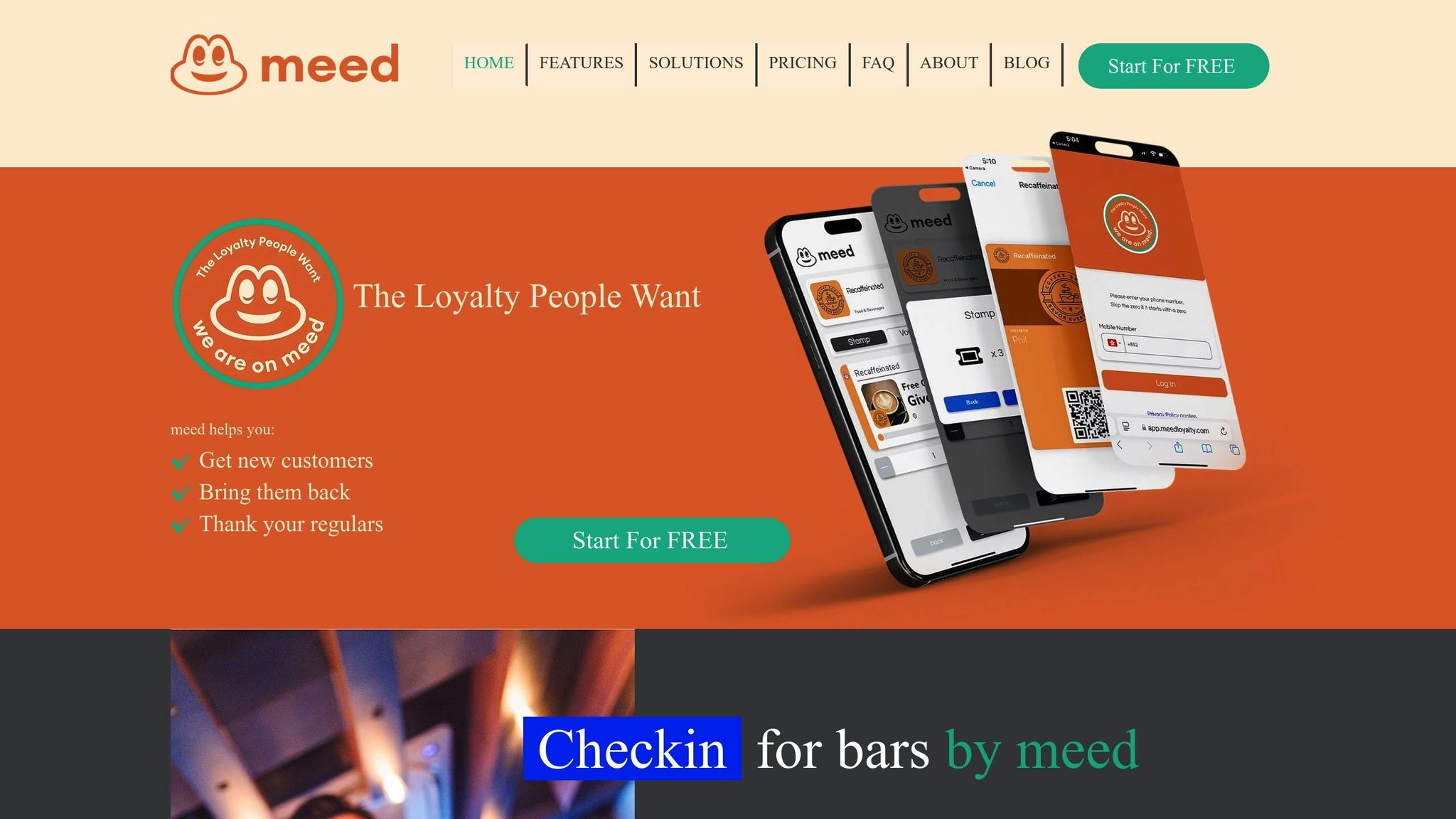
Managing program improvements and regular monitoring can feel overwhelming, but platforms like meed are designed to simplify the process. With meed’s analytics dashboard, you can track key metrics – such as adoption rates, redemption patterns, and customer engagement – in real time, making it easier to identify trends and measure the impact of your changes.
Meed also supports multi-location programs, ensuring consistency across all sites while letting you compare performance between locations. This feature is particularly useful for identifying what’s working in top-performing locations and applying those strategies elsewhere. Tools like digital stamp cards and QR code rewards streamline the customer experience, potentially increasing feature adoption. Plus, integration with Apple and Google wallets reduces friction during reward redemption.
On top of that, meed’s customizable rewards system allows you to experiment with different reward structures and track their impact on your metrics. Whether you’re aiming to boost redemption rates or increase overall engagement, meed makes it easy to test and refine your approach. And with AI-guided receipt scanning, you’ll have access to more accurate data for meaningful analysis and comparisons.
Conclusion: The Value of Benchmarking Loyalty Feature Adoption
A solid benchmarking process is like a compass for your loyalty program – it takes raw data and turns it into actionable steps that fuel customer growth and revenue. It’s not just about collecting numbers; it’s about making those numbers work for you.
The stats speak volumes: brands implementing loyalty programs see an 8.5x ROI within just 90 days, with members spending up to 40% more than non-members. Even more striking, customers who redeem rewards spend up to 164.4% more than those who don’t. These numbers underline why benchmarking is so critical – it helps uncover what’s driving success and what needs fine-tuning to unlock even greater potential.
Benchmarking also helps you zero in on underperforming features, which is crucial when you realize that less than 7% of features drive 80% of engagement. Without optimization, most features in a loyalty program can go unnoticed or underutilized. This process ensures your program is not just functional but impactful.
Consistency is key. A customer who joins a loyalty program is 47% more likely to make a second purchase than a non-member, but only if the program continues to meet their expectations. By regularly comparing your performance to industry benchmarks, you can stay ahead of shifting customer demands and keep competitors at bay.
Platforms like meed make this process easier by offering tools for real-time tracking and refinement. With features like AI-powered receipt scanning and seamless wallet integration, meed reduces friction in the customer experience while providing the data needed for meaningful analysis. Testing reward structures and monitoring changes becomes a streamlined process, enabling you to adapt quickly.
The takeaway? Clear metrics lead to smarter decisions. By tracking and comparing your program’s performance against industry standards, you can make precise adjustments that enhance engagement, boost retention, and turn customers into loyal advocates. Benchmarking isn’t a one-time task – it’s an ongoing cycle that ensures your loyalty program evolves alongside your customers, driving both satisfaction and revenue.
FAQs
How can businesses ensure accurate and compliant data when benchmarking loyalty feature adoption?
To ensure reliable data when evaluating loyalty feature adoption, businesses should focus on data validation. Regular audits and cross-checks are crucial for spotting and resolving inconsistencies early, keeping the data accurate and dependable.
Equally important is adhering to data privacy regulations like GDPR and CCPA. This means securing clear user consent and safeguarding personal information. Strong security measures paired with staying informed about evolving legal requirements not only ensure compliance but also build customer trust.
By prioritizing these steps, businesses can confidently assess their loyalty feature adoption while upholding both accuracy and legal standards.
How can businesses use industry benchmarks to improve their loyalty programs?
Businesses can leverage industry benchmarks to assess critical loyalty program metrics such as customer engagement rates, redemption rates, and retention rates. By stacking their performance against industry standards, companies can pinpoint areas where they’re excelling, spot opportunities for improvement, and set achievable growth targets.
Consistent benchmarking helps fine-tune loyalty strategies, adopt effective practices, and maintain a competitive edge. By learning from high-performing programs, businesses can craft loyalty initiatives that resonate more with customers, boost satisfaction, and deliver stronger returns on investment.
Why is customer feedback important for improving loyalty features and increasing adoption rates?
Customer feedback plays a key role in shaping loyalty features, offering a direct window into what customers genuinely want and need. By pinpointing their preferences and addressing pain points, businesses can make focused adjustments that improve the overall experience and better meet customer expectations.
Taking customer input seriously also fosters trust and strengthens engagement. When people notice that their suggestions lead to real changes, they feel appreciated, which encourages them to stay involved in loyalty programs. This kind of responsiveness not only deepens customer loyalty but also boosts participation, making the program more successful and impactful.