
Mobile-first loyalty programs are reshaping how brands engage with customers. With smartphones now serving as wallets and shopping assistants, digital loyalty programs are replacing outdated physical cards. Here’s why this matters and how to get it right:
- Digital wallet spending is projected to hit $16 trillion by 2028. Integrating loyalty programs with mobile wallets like Apple Wallet or Google Wallet keeps your brand accessible and visible.
- Examples of success: Starbucks‘ mobile app users visit stores 5.6x more often, and NikePlus app shoppers spend 3x more than guest users.
- Key benefits: Mobile-first programs simplify enrollment (QR codes, one-tap sign-ups), boost engagement (60% increase with mobile wallets), and drive retention (existing customers are 60%-70% more likely to buy again).
Steps to design a successful program:
- Define clear goals: Focus on retention and customer lifetime value (CLV) over just acquiring new users.
- Choose the right model: Points-based, tiered, gamified, or referral systems – each has strengths depending on your audience.
- Prioritize simplicity: Streamline onboarding with QR codes or wallet integration. Avoid complex forms or navigation.
- Personalize rewards: Use customer data to tailor offers and segment users (e.g., frequent shoppers vs. deal hunters).
- Leverage mobile features: Real-time updates, location-based notifications, and dynamic progress tracking keep users engaged.
Use metrics to improve: Track redemption rates, wallet adoption, and purchase frequency. Make adjustments based on analytics and customer feedback.
A mobile-first approach isn’t just convenient – it’s essential for driving loyalty and maximizing customer engagement.
Free coffee? Creating Loyalty Cards for Google Wallet
Setting Goals and Choosing Your Loyalty Model
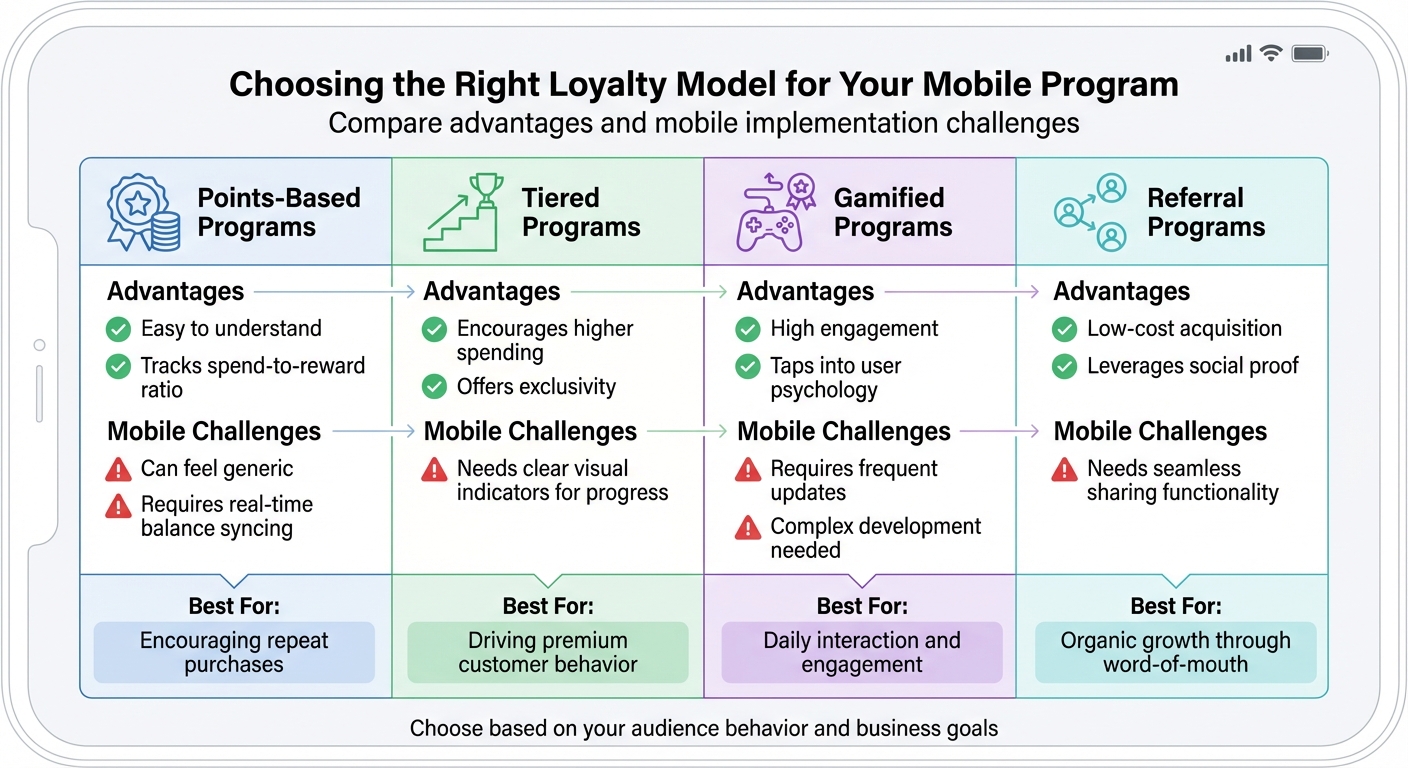
Mobile-First Loyalty Program Models Comparison Chart
Before diving into a loyalty program, it’s crucial to define your goals. Are you aiming to increase how often customers visit? Encourage them to spend more per transaction? Or transform occasional shoppers into devoted fans? Your answers will shape every decision, from the rewards you offer to the metrics you track. Keep in mind that 80% of your future profits will likely come from just 20% of your current customers. That’s why focusing on retention and customer lifetime value (CLV) often delivers better results than chasing new sign-ups.
Defining Objectives and Metrics
Start by setting clear KPIs to guide your program. For instance, tracking customer lifetime value (CLV) helps you measure how much revenue each member contributes over time. Monitoring purchase frequency shows whether your program is encouraging shoppers to visit more often. Keeping an eye on average transaction value (ATV) reveals if customers are spending more per trip. And don’t forget redemption rates – with the average sitting at just 49.8%, nearly half of all rewards go unused. If your customers aren’t redeeming rewards, it’s a sign they’re not fully engaged.
The numbers speak for themselves: existing customers are 60%–70% more likely to make a purchase, compared to just 5%–20% for new prospects. That’s why your metrics should lean heavily toward retention rather than acquisition. Real-time tracking of point balances, tier status, and redemption activity is essential. This data helps you identify issues early – like customers who sign up for a one-time discount but never come back.
Once your objectives and metrics are in place, it’s time to explore different loyalty models that align with your goals.
Comparing Loyalty Models
Each loyalty model has its strengths and challenges, and the one you choose should reflect your brand’s values and your customers’ preferences.
- Points-based programs are straightforward: customers earn points for every dollar spent and exchange them for rewards. They’re great for encouraging repeat purchases, but they can feel uninspired if too many brands use the same approach.
- Tiered programs add a layer of exclusivity by offering better perks as customers spend more. Think color-coded passes or tier names that signal status. They’re effective for driving higher spending but need clear visual indicators, especially on mobile apps, to keep users aware of their progress.
- Gamified programs take engagement to the next level by incorporating challenges, progress bars, and unlockable rewards. This taps into gaming psychology, encouraging daily interaction. However, they require constant updates and more complex development to stay fresh.
- Referral programs focus on leveraging social proof to bring in new customers. They’re cost-effective but rely on seamless sharing features within your app to work smoothly.
Here’s a quick comparison:
| Loyalty Model | Advantages | Challenges for Mobile |
|---|---|---|
| Points-Based | Easy to understand; tracks spend-to-reward ratio | Can feel generic; requires real-time balance syncing |
| Tiered | Encourages higher spending; offers exclusivity | Needs clear visual indicators for progress |
| Gamified | High engagement; taps into user psychology | Requires frequent updates and complex development |
| Referral | Low-cost acquisition; leverages social proof | Needs seamless sharing functionality |
The right model depends on your audience. For example, Nike doesn’t just reward purchases – they reward activity, like completing workouts through their app. Starbucks, on the other hand, transitioned from frequency-based to spend-based rewards after noticing customers were gaming their system. Use your data to guide your choice: if your customers prefer instant rewards, a points-based system may be ideal. If they value recognition and status, a tiered program could be a better fit.
Designing a Simple Mobile User Experience
Once you’ve chosen your loyalty model, the next step is to make the program as straightforward as possible. If your mobile experience involves too many steps, confusing navigation, or hidden features, customers might give up before they even earn their first reward. The aim? Remove every obstacle – from sign-up to reward redemption.
Streamlining Onboarding
Getting customers onboard quickly and easily is crucial. Many traditional loyalty programs lose participants during onboarding because they require app downloads, account setups, and tedious form-filling. Yet, 92% of customers prefer saving loyalty cards in mobile wallets like Apple Wallet or Google Wallet, rather than downloading a dedicated app. The most successful mobile-first programs skip the app entirely and focus on integrating directly with these digital wallets.
Here’s how you can simplify the process:
- Use device-aware links that detect whether the customer is on iOS or Android, enabling them to add the correct wallet pass with just one tap.
- Eliminate the need for usernames, passwords, or long forms by pulling details directly from the device’s contact settings – like Apple’s “My Card” feature – to prefill names and email addresses.
- Encourage immediate action by offering a welcome reward, such as bonus points, a free item, or an exclusive discount, as soon as the customer adds your pass to their wallet.
- Place QR codes for enrollment on physical receipts, email signatures, and checkout pages, so customers can sign up when they’re already interacting with your brand.
This one-click, frictionless enrollment process makes joining your program effortless.
Adding User-Friendly Features
Once customers are signed up, keeping them engaged requires intuitive and rewarding features. Digital stamp cards are a great example – they mimic the traditional punch-card experience while providing real-time updates. Customers can instantly see how many visits or purchases they need to unlock their next reward, with a visual progress bar that taps into the same psychology that makes gaming so engaging.
Another way to simplify the experience is by using QR code rewards. At checkout, a quick scan applies points or discounts automatically – no manual input required. This seamless, one-tap interaction is essential, especially since customers interact with mobile wallet cards three times more often than traditional loyalty cards.
Platforms like meed make this process even easier by offering digital stamp cards, QR code rewards, and integration with Apple and Google Wallets – all without requiring a separate app. This not only reduces development costs but also speeds up your program’s launch. Plus, customers can access their loyalty card right from their lock screen as they walk into your store.
"Clear, simple UX is non-negotiable, confusing loyalty flows kill engagement instantly." – Kate Banasik, Voucherify
Lastly, ensure your mobile pass provides essential details – like member ID, current points, and tier status – at a glance. Avoid clutter and unnecessary scrolling. When customers can quickly see what they have and what they can redeem, it creates a better user experience. These small but impactful improvements lay the groundwork for advanced features like real-time updates and tailored rewards.
Using Apple Wallet and Google Wallet Integration
A mobile-first approach becomes even more powerful with wallet integration, making it easier for customers to engage with your loyalty program. By integrating your loyalty cards into Apple Wallet and Google Wallet, customers can store them alongside their credit cards, boarding passes, and tickets. This setup simplifies pass management and ensures your program is always just a tap away.
Simplifying Pass Management
Adding a loyalty card to a customer’s wallet should be quick and effortless. Whether through your website, email, SMS, QR codes, or NFC tags, the process should take seconds. Use the official "Add to Apple Wallet" and "Save to Google Wallet" badges to make the action instantly recognizable.
For Apple Wallet, the "Automatic Invitation" feature streamlines enrollment. After completing an Apple Pay transaction, customers can receive a prompt to join your loyalty program. Details like their name and email can even be pre-filled using the device’s "My Card" contact settings, turning sign-up into a one-tap process. Google Wallet offers similar ease with its REST API, which lets you generate passes on demand by embedding customer data into a signed JWT.
Once the pass is added, it syncs across all of the customer’s devices. For example, adding a loyalty card on an iPhone automatically makes it available on an Apple Watch via iCloud. This ensures your loyalty program is accessible whether customers are shopping in-store, online, or even browsing from their wrist.
After the initial setup, regular updates keep the pass current and engaging.
Real-Time Updates and Notifications
Dynamic updates are a standout feature of wallet integration. Whenever customers earn points, redeem rewards, or level up, their digital pass refreshes instantly. This can happen automatically through server pushes or manually when the customer refreshes the pass.
Location-based triggers take engagement a step further. By embedding geographic coordinates into your pass metadata, the loyalty card can appear on a customer’s lock screen when they’re within 100 meters (about 328 feet) of your store. This strategy has been shown to increase store visits by 23% compared to random notifications. Apple Wallet even allows up to 10 locations on a single pass, making it perfect for businesses with multiple locations.
To avoid overwhelming customers, limit notifications to two or three meaningful updates per week. Focus on key moments like double-points weekends, birthday rewards, or reminders that a customer is just one purchase away from a free item. Timing these alerts during peak shopping hours can maximize their impact.
For a smooth, contactless experience, Apple’s Value Added Services (VAS) protocol and Google’s NFC-enabled Smart Tap allow customers to earn and redeem rewards with a single tap at checkout. The loyalty pass is automatically applied during payment, merging payment and reward tracking into one seamless interaction. However, this requires an NFC certificate from Apple and VAS-certified POS terminals.
If managing the technical side of wallet integration feels daunting, platforms like meed can handle the heavy lifting. They take care of certificates, server endpoints, and push notification infrastructure, so you can focus on creating rewards that keep customers coming back. Their platform supports both Apple and Google Wallets, offering features like real-time updates and location-based triggers – even on their free Starter plan.
sbb-itb-94e1183
Personalizing Rewards with Customer Data
Gone are the days when generic rewards could keep customers engaged. Today, people expect loyalty programs to feel personal and relevant. By using mobile wallet enrollment and transaction data, businesses can craft experiences that feel tailor-made. This level of personalization can lead to a boost in redemption rates – up to 40% more, according to research.
The first step? Segment your customers into meaningful groups to offer rewards that resonate.
Segmenting Customers for Targeted Rewards
To personalize effectively, start by organizing your customers into segments that reflect their behaviors and preferences. A great tool for this is RFM analysis, which looks at Recency, Frequency, and Monetary value. This analysis helps identify your most loyal customers, those who might be slipping away, and everyone in between.
For example, a coffee shop might classify its customers into groups like:
- Daily commuters: Regular weekday visitors grabbing their morning coffee.
- Weekend warriors: Those who stop by only on Saturdays.
- Deal seekers: Shoppers who appear during promotional periods.
Each of these groups requires a unique approach. Your top 20% of customers – who are likely responsible for 80% of your future profits – might appreciate perks like early access to new products or invitations to VIP events. On the other hand, dormant customers could be re-engaged with a "we miss you" offer, like a free item. For new customers, simple incentives such as a "buy one, get one 50% off" deal after their first purchase can encourage repeat visits.
Mobile wallets make it easier to act on this segmentation in real-time. For instance, when a customer’s loyalty tier or personalized offer updates, it can instantly appear on their lock screen. This kind of visibility drives engagement, as mobile wallet users tend to interact with rewards 23% more often than traditional cardholders.
Using AI and Analytics for Personalization
Artificial intelligence takes personalization to the next level by anticipating customer needs. For instance, if someone consistently buys an iced latte every Tuesday morning, predictive analytics can send them a discount notification the night before. Similarly, receipt scanning technology can consolidate offline purchases into a unified digital profile, creating a seamless experience.
Here’s a quick look at how personalization strategies can work:
| Personalization Technique | Data Source | Practical Application |
|---|---|---|
| Behavioral | Purchase history, visit frequency | Sending morning drink offers to daily commuters |
| Contextual/Geo | Real-time GPS location | Triggering offers when customers are near your store |
| Predictive (AI) | Spending patterns | Offering discounts on items a customer regularly buys |
| Tier-Based | Total spend, membership level | Giving "Gold" members early access to sales |
| Event-Based | Birthdays, anniversaries | Sending surprise rewards on special occasions |
To make all of this work smoothly, integrate your POS system, CRM, and mobile wallet platform using APIs. This ensures data flows effortlessly, allowing updates to happen in real-time. For instance, when a customer reaches a new tier, their digital pass should automatically refresh across all platforms. Tools like meed can handle this synchronization, keeping point balances and tier statuses up to date.
Don’t forget to test and refine your offers. Experiment with variables like offer value, expiration dates, and messaging. If redemption rates for AI-driven offers fall below 15%, it could mean the timing or relevance needs adjustment.
Increasing Engagement Through Gamification and Multi-Channel Strategies
Once you’ve established a solid mobile-first and wallet-integrated loyalty program, the next step is to focus on strategies that deepen customer engagement. That’s where gamification and multi-channel approaches come into play. While personalization sparks initial interest, gamification ensures customers keep coming back. Adding game-like features taps into people’s natural drive for achievement and progress. Pair that with a multi-channel strategy, and you’ll keep your program in customers’ minds without overstepping.
Adding Gamification Features
Gamification thrives on three key elements: points to track progress, levels to show advancement, and badges to celebrate milestones. These aren’t just flashy add-ons – they create a sense of accomplishment that encourages repeat interactions.
For example, visual progress bars are especially effective on mobile. Seeing that they’re only 20 points away from earning a free coffee can prompt customers to act right away. Make sure this “next reward” threshold is always clearly visible on their digital pass. Features like shake-to-win games or daily lotteries can also boost engagement, encouraging users to check in regularly. The trick is to strike the right balance: tasks should be engaging but not overly difficult, with gradual challenges that keep users motivated and in a “flow” state.
Adding social elements, like leaderboards or team challenges, taps into our competitive instincts while building a sense of community. Gamification isn’t just about making your app more fun – it’s about weaving these features into every customer interaction. By integrating these elements across all channels, you can expand your program’s reach and keep it relevant.
Driving Engagement Across Channels
Integrating your loyalty program with mobile wallets ensures it’s always visible – right on your customers’ lock screens. Wallet card push notifications, for instance, boast open rates of nearly 90%, with users receiving these updates logging 53% more monthly sessions.
"Loyalty programs with native mobile integration with omnichannel features such as messaging, location technology, beacons, real-time offers, card-linked offers, and exclusive member benefits will be the ones to garner real attention and adoption moving forward."
– Dominic Machado, Capillary Technologies
Timing matters. Limit push notifications to 2–3 per week and avoid sending them during early mornings or late nights to avoid overwhelming users. Geofencing can also be a game-changer – trigger location-based notifications when customers are within 100 meters of your store. This approach drives foot traffic without feeling invasive.
Make it easy for customers to access loyalty passes by offering multiple distribution options: in-store QR codes, email links, SMS, or website checkout pages. Use device-aware links to ensure users on iOS or Android receive the correct wallet pass with a single tap. For app users, deep linking can take them directly to specific sections of your app for a seamless experience.
Platforms like meed help synchronize these efforts across channels, ensuring customers always have access to accurate, up-to-date rewards information. This level of consistency not only builds trust but also keeps engagement high by eliminating frustrations caused by outdated or conflicting details.
Monitoring and Improving Program Performance
Once you’ve implemented mobile-first features to boost engagement, the next step is to measure how well they’re working. Regularly tracking performance helps you pinpoint what’s working and what needs adjustment.
Key Metrics to Track
To get a full picture of your program’s performance, focus on these metric categories:
- Financial Metrics: Keep an eye on Customer Lifetime Value (CLV), Average Order Value (AOV), Return on Investment (ROI), and Sales Lift to understand profitability and spending trends.
- Engagement Metrics: Monitor redemption rates, push notification click-through rates (CTR), and app sessions to gauge customer interaction.
- Retention Metrics: Look at churn rate and purchase frequency to see how well you’re keeping customers engaged over time.
- Mobile-Specific Metrics: Track wallet adoption and proximity offer performance to evaluate how mobile features are performing. For example, customers using wallet-based programs interact 40% more often than those using traditional card systems.
- Advocacy Metrics: Metrics like Net Promoter Score (NPS), referral rates, and social mentions reveal customer sentiment and how much organic growth your program is generating.
Here’s a quick snapshot of what these metrics tell you:
| Metric Category | Key Indicators | What It Reveals |
|---|---|---|
| Financial | CLV, AOV, ROI, Sales Lift | Profitability and customer spending growth |
| Engagement | Redemption Rate, Push Notification CTR, App Sessions | Customer interaction levels |
| Retention | Churn Rate, Purchase Frequency | How often customers return |
| Mobile-Specific | Wallet Adoption (target: 40–60%), Proximity Offer Performance | Success of mobile-first features |
| Advocacy | NPS, Referral Rate, Social Mentions | Brand loyalty and organic growth |
It’s worth noting that loyalty programs typically see an average redemption rate of 49.8%. However, personalized rewards can push that number past 60%. Mobile wallet notifications are particularly effective, with open rates reaching as high as 90%. And don’t forget, 80% of future profits often come from just 20% of your existing customers.
Continuous Improvement Through Analytics
To keep your program effective, use analytics to refine your approach. Tools like A/B testing and cohort analysis can help you improve elements like reward values, notification timing, and onboarding flows. For instance, if you notice higher activity over the weekend, try scheduling notifications on Friday afternoons.
Cohort analysis is especially useful for distinguishing between short-term spikes and lasting loyalty. If you notice a high number of card views but few transactions, it might mean your rewards feel too hard to achieve. Similarly, tracking the time between a card save and a first purchase can help you optimize the onboarding experience.
Segmenting your customers can also offer valuable insights. Group them into categories like "high-frequency", "seasonal", "deal seekers", or "premium buyers", and tailor your strategy for each group. To make data collection less overwhelming for users, consider progressive profiling – gathering demographic info gradually rather than all at once during sign-up. Platforms like meed offer analytics dashboards that simplify tracking these metrics without requiring custom reporting setups.
Daily monitoring of API performance is another crucial step. It ensures smooth point synchronization and prevents customer frustration. Combine this data with insights from in-app surveys and customer service logs to identify and address technical or user experience issues.
Finally, real-time adjustments can make a big difference. For instance, if location-based alerts aren’t delivering the expected 23% increase in store visits, tweak your geofencing settings or timing. Dynamic content updates also allow you to modify underperforming offers instantly, without needing users to update their digital passes. By staying flexible and data-driven, you can keep your loyalty program running smoothly and effectively.
Conclusion
Creating a thriving mobile-first loyalty program revolves around four key principles: a seamless user experience, integration with mobile wallets, personalized, data-driven rewards, and ongoing adjustments. With 92% of customers preferring to store loyalty cards in their mobile wallets instead of downloading separate apps, it’s clear that moving beyond physical cards and standalone apps is no longer optional – it’s a necessity.
These strategies deliver real results. Mobile wallet-based loyalty programs see a 40% increase in usage, while personalized rewards drive redemption rates up by over 40%. Additionally, 80% of future profits often come from just 20% of your current customers.
Make onboarding effortless by offering one-tap enrollment through NFC or QR codes. A smooth mobile experience not only simplifies the sign-up process but also opens the door to more personalized and engaging interactions. Use tools like real-time push notifications and location-based triggers to keep your loyalty program front and center – literally, on your customers’ lock screens. Tailor offers to customer segments, whether they’re frequent shoppers, seasonal buyers, or deal hunters. Add excitement with gamification features like progress bars or tiered rewards to encourage daily engagement. And don’t forget – strong security measures are essential for building lasting trust.
For long-term success, think of your loyalty program as an evolving system. Keep an eye on metrics like redemption rates, wallet adoption, and customer lifetime value. Experiment with A/B testing to refine offer values and notification timing. If location-based alerts aren’t performing well, tweak your geofencing settings. A drop in redemption rates? Revisit your rewards structure and timing. By using analytics and making timely adjustments, you can ensure your program stays relevant and effective over time.
FAQs
How do mobile-first loyalty programs improve customer engagement compared to traditional methods?
Mobile-first loyalty programs put the entire rewards experience right in the palm of your hand – on your smartphone. Forget about carrying physical cards or downloading extra apps. By embedding loyalty passes directly into Apple Wallet or Google Wallet, brands can deliver real-time updates like points balances, exclusive deals, and seasonal promotions straight to your lock screen. Rewards are always just a tap away.
This streamlined setup makes joining a program effortless, eliminates the frustration of forgotten passwords, and ensures rewards are ready to use at checkout. Features like location-based alerts and tailored offers make the experience even more engaging, encouraging casual shoppers to stick around and become repeat customers. As more people expect loyalty programs to work seamlessly on their phones, this modern approach offers a convenient way to boost both participation and satisfaction.
What should I consider when selecting the best loyalty program model for my business?
To design a loyalty program that works for your business, start by matching the program’s structure to your goals and customer habits. Are you aiming to encourage repeat visits, increase the average spend per visit, or turn customers into passionate brand advocates? Your answer will guide you toward the right model – whether it’s a points-based system, digital stamp cards, tiered rewards, or a mix of approaches that reward both frequent visits and higher spending.
Make sure your program is mobile-friendly for maximum convenience and engagement. Features like one-tap enrollment through Apple Wallet or Google Wallet can make joining effortless and reduce the chances of customers dropping off. Don’t overlook security – your platform should use encryption, support NFC or QR code verification, and comply with U.S. privacy laws to protect user data.
Scalability and personalization are also key. Incorporate features like real-time notifications, location-based offers, and flexible rewards to keep users engaged. Integrating the program with your existing CRM or POS system allows you to track customer behavior, create audience segments, and fine-tune rewards as needed. By focusing on ease of use, robust security, and the ability to grow with your business, you can build a loyalty program that keeps your customers coming back while driving measurable results.
How can I use customer data to create personalized rewards in a mobile-first loyalty program?
To make rewards truly resonate with your customers, start by tapping into first-party customer data – things like purchase history, product preferences, location check-ins, and in-app activity. By securely managing this data, you can craft personalized rewards, such as digital stamp cards or QR code perks that sync effortlessly with Apple Wallet and Google Wallet.
From there, segment your audience based on their behaviors. For instance, identify frequent visitors or spot specific spending habits. Assign relevance scores to these groups and deliver tailored offers – like location-based coupons or instant perks – right to their mobile wallets. This ensures rewards are not only personalized but also timely and engaging, adding value to their experience.
Lastly, keep refining your strategy. Analyze how often rewards are redeemed, gather customer feedback, and adjust accordingly. Always prioritize transparency by obtaining consent before using customer data and clearly outlining the benefits of personalized rewards. With real-time insights and a mobile-first mindset, you can create a rewards system that feels natural and builds deeper customer loyalty.