
If you’re deciding between Apache Unomi and Open Loyalty, here’s the key takeaway: Apache Unomi is a customer data platform (CDP) focused on managing and analyzing customer data for personalization, while Open Loyalty is a loyalty program platform designed to help businesses boost customer retention through rewards and gamification.
Quick Overview:
- Apache Unomi: Ideal for businesses prioritizing data privacy, real-time personalization, and multi-channel customer data management. It’s open-source but requires technical expertise for setup.
- Open Loyalty: Tailored for businesses needing customizable loyalty programs. Its API-first design makes it easier to integrate into existing systems and launch quickly.
Quick Comparison:
| Feature | Apache Unomi | Open Loyalty |
|---|---|---|
| Purpose | Customer data platform | Loyalty program management |
| Architecture | Java-based, open-source | API-first, headless SaaS |
| Key Strengths | Data unification, GDPR compliance | Gamification, tiered rewards |
| Best For | Personalization, multi-channel data | Loyalty programs, customer retention |
| Integration | REST API, custom extensions | APIs, webhooks |
| Hosting | Self-hosted | SaaS |
| Scalability | Horizontal scaling for data | Handles high loyalty transactions |
| Ease of Use | Requires technical setup | Faster to implement |
Apache Unomi suits businesses needing in-depth customer insights and privacy controls, while Open Loyalty is better for companies focusing on rewarding and engaging customers through loyalty initiatives.
Apache Unomi Overview
Apache Unomi is an open-source customer data platform (CDP) developed in Java, designed to help businesses collect, manage, and analyze customer data from various touchpoints. As the reference implementation of the OASIS Context Server Customer Data Platform standard, it became an Apache Top-Level Project in 2020, underscoring its readiness for enterprise use.
What sets Unomi apart is its ability to consolidate customer data into detailed profiles that go beyond basic behavioral tracking. It transforms raw data into actionable insights, enabling businesses to deliver real-time personalization and targeted marketing strategies.
Main Features
Apache Unomi comes packed with features that cater to modern customer data management needs. Its real-time customer profile creation is a standout capability. As users interact with digital platforms, Unomi builds detailed profiles on the fly, leveraging an ElasticSearch backend for fast data retrieval and analysis across extensive datasets.
One of its most practical tools is the rule-based personalization engine, which automates responses based on customer behavior. For example, in an e-commerce scenario, Unomi can tag products like "Autumn Collection" and assign higher scores to users who frequently browse related categories, click on product links, watch videos, or complete purchases. This scoring system feeds into dynamic, personalized recommendations, discounts, and promotions tailored to each customer.
Unomi also prioritizes privacy and compliance, with built-in anonymization features to safeguard user data. It automates visitor consent management, ensuring businesses stay aligned with GDPR and other data protection regulations.
Thanks to its modular and scalable design, Unomi is versatile enough to accommodate businesses of varying sizes. It offers a RESTful API for seamless integration with existing systems and allows for custom extensions to meet specific needs.
Its segmentation and scoring tools further enhance its utility. Businesses can group customers based on behavior, preferences, or engagement levels, adjusting scores dynamically through custom rules. These capabilities work hand-in-hand with Unomi’s segmentation features, allowing for highly targeted campaigns across different customer groups.
Best Use Cases
Apache Unomi shines in multi-channel customer data management, making it a go-to solution for several industries.
- E-commerce platforms leverage Unomi to deliver tailored product recommendations and promotions based on browsing and purchase behaviors.
- Media and content websites use it to personalize articles, videos, and ads. By tracking engagement, Unomi adjusts content dynamically to keep visitors engaged longer.
- Companies with complex integration needs find Unomi particularly useful. It works seamlessly as a personalization service for web content management systems, an analytics tool for mobile apps, or a centralized profile manager pulling data from CRMs, forums, and other sources.
- Regulated industries value Unomi’s privacy-first approach. For example, it has been used to monitor individuals with addictions, helping prevent relapses while maintaining strict privacy controls. Another use case involved real-time personalization powered by event data analysis, all while adhering to stringent privacy standards.
- Loyalty program management is another area where Unomi excels. Its scoring system tracks customer engagement and triggers rewards or offers when specific thresholds are met, automating the process of recognizing and incentivizing loyal customers.
"Each organization is unique and will always have specific needs, this is why Apache Unomi™ has been designed to be extended and to ease the integration of external data. The embedded features such as segmentation, scoring and built-in privacy will be appreciated by business users while horizontal scalability and open source positioning will be loved by developers and architects."
Users consistently praise Unomi for its functionality (4.5/5) and user experience (4/5). However, implementing the platform requires technical expertise, reflected in its technical skill requirement rating of 1/5.
Open Loyalty Overview
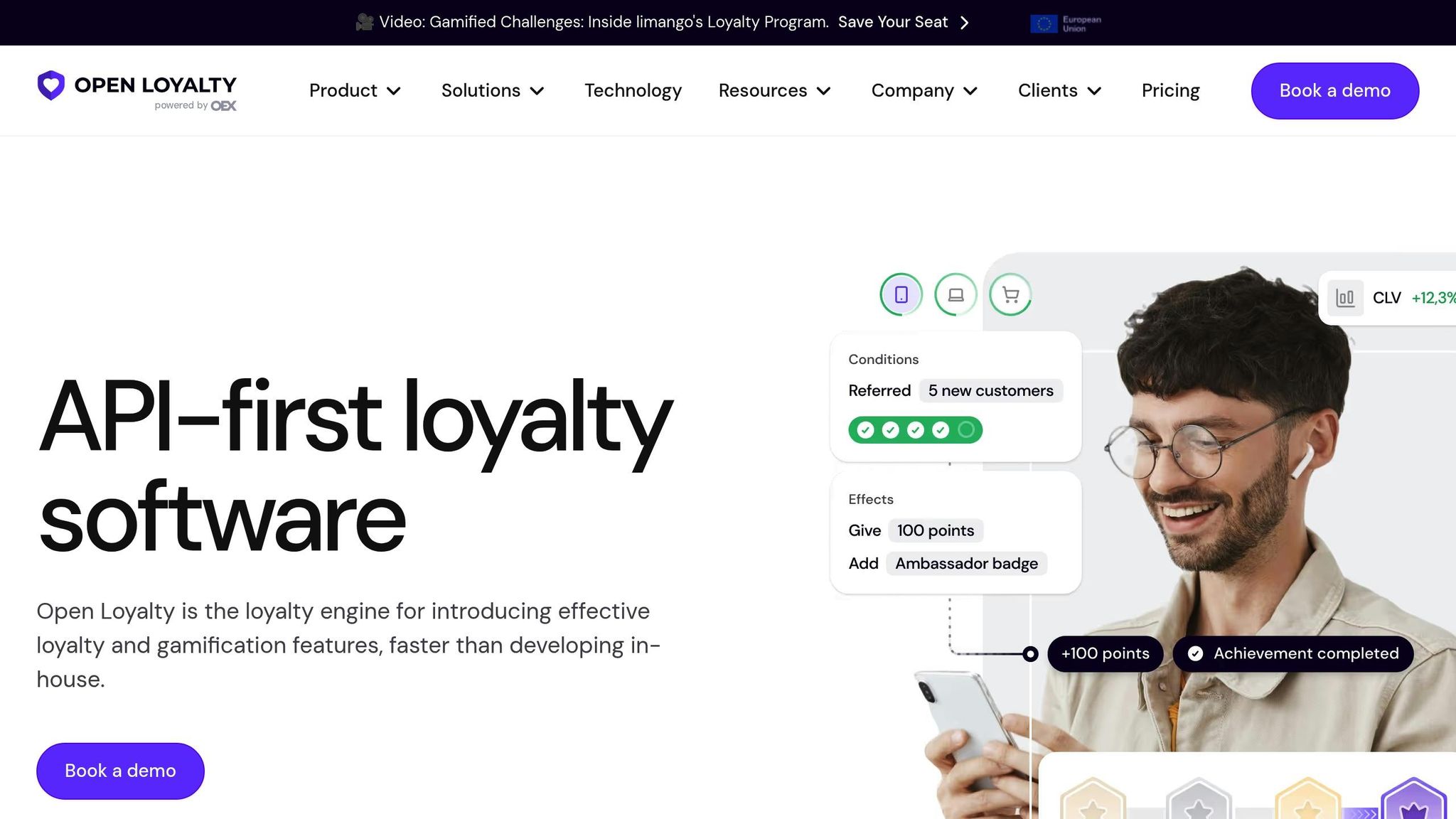
Open Loyalty is a modular, API-first loyalty platform built to seamlessly integrate with existing technology systems and provide highly tailored customer engagement solutions. Its headless architecture ensures that the back-end loyalty engine operates independently of front-end interfaces, allowing businesses to develop mobile, web, and in-store applications without disrupting the core system. This design sets it apart from platforms that primarily focus on data aggregation, offering a fresh approach to loyalty management.
Open Loyalty’s scalability is impressive, processing 800 million loyalty events annually while maintaining 99.99% uptime and delivering an average API response time of 120 milliseconds. It serves leading brands across 45 countries, making it a trusted solution for enterprises aiming to enhance customer experiences through technology.
Main Features
Open Loyalty stands out with its versatile loyalty mechanics and developer-friendly integration tools. The platform supports an array of engagement strategies, such as points systems, tiered programs, digital wallets, achievements, coupons, referral initiatives, badges, and reward catalogs.
Its campaign builder is a standout feature, enabling businesses to create detailed loyalty rules without extensive coding. For instance, companies can configure custom event schemas and automate responses like awarding points for specific actions or triggering personalized offers based on purchasing habits.
For technical teams, Open Loyalty offers extensive integration options through its Open API, webhooks, and file-based data import/export systems. These tools allow seamless integration with existing CRMs, e-commerce platforms, and other business software.
The platform also boasts advanced segmentation and analytics tools, enabling businesses to group customers by behavior, preferences, or engagement levels. This data can be visualized through detailed dashboards that track program performance.
On the enterprise side, Open Loyalty ensures compliance and security standards are met. It supports multi-tenancy for managing multiple brands, offers multi-language support, role-based access control, audit logs, and adheres to GDPR and ISO standards. Single sign-on (SSO) integration is also available.
Best Use Cases
The platform’s features translate into real-world benefits across various industries. Open Loyalty is particularly effective for businesses needing custom loyalty solutions and equipped with technical teams to implement API integrations. Its success stories span multiple sectors, showcasing its versatility.
E-commerce and retail businesses have achieved remarkable results. For example, limango, a German online retailer, leveraged Open Loyalty’s gamification tools to triple customer buying frequency and increase average order value by 41%. Similarly, EQUIVA implemented gamified referral programs that doubled purchase frequency and saved €68,000 within months of launch.
Digital health and wellness platforms have also benefited. dacadoo, a health app, used Open Loyalty’s mobile gamification features to boost user activation rates by 62%.
For enterprise brands with complex needs, the platform’s flexibility is a major advantage. Thomas Archer Bata from ALDO Group shared:
"The Open Loyalty customer loyalty program software allows us a lot of flexibility in building these dynamics and delivering a strong experience for our consumers."
Organizations with existing technology stacks value its seamless integration capabilities. Nicole Kusi from the United States Soccer Federation highlighted:
"We loved what the API had to offer as we knew it was going to be a code integration, as well as some of the out-of-the-box features. We are extremely happy with the usability."
Open Loyalty is also well-suited for industries like banking and finance, convenience stores, FMCG, and fuel retail. Prominent brands such as JTI, Intersport, and Heineken have successfully used the platform to elevate their customer engagement strategies.
The platform consistently earns high user ratings, including a 4.8/5 score on Capterra. Users frequently commend its reliable customer support and clear API documentation. One reviewer noted:
"The API documentation is kept up to date and is easy to consume. The team at Open Loyalty are great, they consistently provide good service and are willing to help if required."
Side-by-Side Comparison
Building on the overviews above, let’s dive into a side-by-side analysis of these platforms. This comparison highlights their core purposes and technical approaches, helping to clarify their distinct business objectives and technical capabilities.
Apache Unomi operates as a customer data platform, designed to gather and analyze customer data from a variety of sources. Its standout feature is the creation of unified customer profiles, enabling highly personalized experiences through advanced segmentation and scoring tools. It’s particularly effective at collecting data from multiple channels – like web apps, mobile platforms, and even in-store beacons – making it a strong choice for businesses focused on gaining deep insights into customer behavior.
Open Loyalty, on the other hand, focuses specifically on loyalty program management. It uses a headless architecture, which decouples the loyalty engine from front-end interfaces, allowing for greater flexibility and integration options.
Feature Comparison Table
| Aspect | Apache Unomi | Open Loyalty |
|---|---|---|
| Primary Purpose | Customer data platform for personalization | Loyalty program management and gamification |
| Architecture | Java-based open-source platform with ElasticSearch storage | Headless SaaS platform with API-first design |
| Data Handling | Unified customer profiles across multiple touchpoints | Loyalty-specific data processing and event tracking |
| Personalization | Advanced segmentation, scoring, and built-in privacy features | Ready-to-use loyalty features |
| Integration Approach | Designed for external data integration and profile sharing | RESTful APIs and webhooks for real-time integration |
| Implementation Speed | Requires technical setup and configuration | Quick to implement with API-level flexibility |
| Scalability | Horizontal scaling for growing customer data volumes | Built to handle high volumes of loyalty transactions |
| Customization | Highly customizable and extensible platform | Flexible building blocks for loyalty program mechanisms |
| Hosting Options | Self-hosted open-source solution | SaaS hosted globally |
| Best For | Web personalization, mobile data collection, beacon integration | Loyalty programs, gamification, and customer engagement |
Now, let’s take a closer look at how these platforms differ in terms of integration and scalability to help determine which might better suit your business needs.
From a technical perspective, both platforms have distinct strengths. Apache Unomi leverages ElasticSearch for data storage alongside a REST API architecture, making it highly capable of managing complex customer data. Its open-source design allows for extensive customization, as emphasized in the official Apache Unomi documentation:
"Each organization is unique and will always have specific needs, this is why Apache Unomi™ has been designed to be extended and to ease the integration of external data."
In contrast, Open Loyalty’s API-first and headless architecture simplifies the integration of loyalty features into existing systems. This design ensures a smooth connection between customer-facing applications and its loyalty engine, offering businesses a seamless way to implement loyalty programs.
Apache Unomi shines when integrated with tools like content management systems (CMS), customer relationship management systems (CRMs), issue trackers, and native mobile apps, enabling comprehensive profile sharing across platforms. Open Loyalty, meanwhile, connects easily with mobile apps, e-commerce platforms, and point-of-sale systems via its RESTful APIs and webhook capabilities. Both platforms are built to scale – Apache Unomi horizontally to handle increasing customer data, and Open Loyalty to support high transaction volumes in loyalty programs.
Ultimately, these technical differences highlight their unique strengths. Apache Unomi is the go-to choice for businesses prioritizing in-depth customer insights and personalization, while Open Loyalty is ideal for those looking to streamline loyalty program management.
Integration Options and Support
When evaluating Apache Unomi and Open Loyalty, understanding their integration capabilities and support systems is crucial for ensuring a smooth implementation. Both platforms take different approaches to connect with existing business tools, catering to varying technical needs.
Apache Unomi Integrations
Apache Unomi is designed to work seamlessly with content management systems (CMS), customer relationship management systems (CRMs), and mobile apps, enabling profile sharing and reuse across applications.
The platform includes several pre-built connectors for popular tools like Salesforce, Twitter, and Mailchimp. Its REST API architecture also allows developers to create custom extensions as needed. For those starting out, Apache Unomi provides integration samples – such as login and Twitter examples – along with a web tracking tutorial to simplify setup. On the other hand, Open Loyalty takes an API-driven approach to connectivity.
Open Loyalty Integrations
Unlike Apache Unomi’s reliance on built-in connectors, Open Loyalty uses an API-first approach for real-time, flexible integrations. It connects with e-commerce platforms, point-of-sale systems, and marketing tools through RESTful APIs and webhooks.
The platform boasts impressive performance, with an average API response time of 120 ms, 99.99% uptime, and the ability to handle 50 million transactions and 800 million loyalty events annually. Real-world examples highlight its capabilities: Limango, a European e-commerce platform, used Open Loyalty’s API to launch behavior-driven campaigns, increasing their average order value by 41%. Similarly, EQUIVA doubled purchase frequency and saved EUR 68,000 within months of implementing gamified referrals through Open Loyalty.
"We used Open Loyalty pre-built modules, applied the loyalty mechanics via API to our tech stack and focused fully on the customer experience."
– Fritze von Berswordt, Managing Director, EQUIVA
Open Loyalty’s modular design allows businesses to enhance existing systems with loyalty and gamification features without requiring a complete overhaul. Its ready-to-use modules and Open API make integration straightforward and efficient.
Support and Documentation
Support and documentation play a key role in ensuring a successful implementation. The two platforms offer distinct approaches in this area.
Apache Unomi provides embedded REST API documentation directly on the server in OpenAPI format. Users also have access to recipes, request examples, and detailed integration samples to help achieve specific goals.
Open Loyalty, however, offers a more hands-on support structure. Its commercial support includes implementation assistance, team training, and dedicated Success Managers for enterprise clients. The platform also provides up-to-date API documentation, sample campaign setups, and best practice guides for integrating with systems like POS, CRM, and mobile apps.
For example, dacadoo, a digital health app, benefited significantly from Open Loyalty’s support framework. Jonas Minke, Head of Product at dacadoo, shared:
"With Open Loyalty we can create user engagement campaigns much more easily and fulfill the requirements of our clients with less restrictions."
– Jonas Minke, Head of Product at dacadoo
Open Loyalty emphasizes careful planning for integrations, recommending workshops, collaboration sessions, and strategic resource allocation. The platform also prioritizes a scalable architecture, considering factors like data storage, API integration, and system performance from the start. For businesses focused on compliance and security, Open Loyalty meets GDPR requirements, holds ISO 27001 and ISO 9001 certifications, and uses AWS hosting with multiple data center options.
Choosing between these platforms ultimately depends on your needs. Apache Unomi provides the flexibility of an open-source solution with community support, while Open Loyalty offers robust commercial support and ready-to-use modules tailored for businesses seeking a SaaS platform.
sbb-itb-94e1183
Which Platform Fits Your Business
Choosing the right platform – Apache Unomi or Open Loyalty – depends on your business’s objectives, technical capabilities, and resources. Here’s a breakdown to help you make the best choice based on your needs.
When to Choose Apache Unomi
Apache Unomi is ideal for businesses that emphasize data privacy, regulatory compliance, and personalized customer experiences. However, it requires a high level of technical expertise for implementation and maintenance.
- Technical Requirements: Apache Unomi lacks a graphical user interface (GUI), so it demands advanced programming skills and significant customization efforts to add features. This makes it a better option for companies with dedicated development teams.
- Privacy-Focused Organizations: Businesses in highly regulated industries or those with strict privacy standards benefit from Apache Unomi’s built-in GDPR consent management. As Andy Kaiser, founder of Ninetailed, stated:
"Apache Unomi was chosen as our CDP due to the logical and plugin architecture, because it is an Apache Open Source project and especially because of its Privacy (GDPR consent management) features. This lets the user own their data, but also marketers and developers improve the user journey to help the users in their decision process and brand experience."
- Custom Solutions for Enterprises: Companies needing tailored customer data management solutions will find Apache Unomi’s modular design advantageous. Serge Huber, CTO of Jahia, shared:
"Apache Unomi, thanks to its strong foundation in Apache Karaf and ElasticSearch, is a very modular, completely open, and performant CDP engine that is a very important foundation of our products. We love Apache Unomi, we work hard to encourage others to adopt it, we are here to help, and we are deeply committed to helping our customers succeed with it."
- Budget-Friendly for Developers: If your business has a skilled technical team but a limited software budget, Apache Unomi’s open-source model can help you avoid licensing fees. However, keep in mind that development costs may be higher.
If your focus shifts toward customer retention through loyalty programs, Open Loyalty might better suit your needs.
When to Choose Open Loyalty
Open Loyalty is a great choice for businesses with in-house development teams looking for an API-first solution with pre-built modules to quickly implement loyalty programs.
Decision Factors
To decide which platform aligns with your business, consider these key factors:
- Technical Expertise: Apache Unomi requires more extensive programming skills for setup and customization, while Open Loyalty’s API-first approach simplifies integration for tech-savvy teams.
- Business Goals: If your focus is on managing customer data and delivering personalized experiences, Apache Unomi might be the better fit. As of July 2025, it holds a 3.6% share in the Customer Data Platforms category. On the other hand, if customer retention is your priority, Open Loyalty’s loyalty program features may align more closely with your objectives.
- Integration Needs: Apache Unomi may require custom development to integrate with existing systems. Open Loyalty’s API-driven design, however, often allows for smoother integration.
- Privacy and Compliance: For companies with stringent privacy requirements, Apache Unomi offers robust GDPR consent management. Consider which compliance aspects are most critical for your operations.
- Budget and Timeline: While Apache Unomi’s open-source nature avoids licensing fees, it may lead to higher development costs. Open Loyalty, with its pre-built modules, can reduce implementation time, though it may include support expenses.
- Scalability: For businesses planning rapid growth, scalability is a key consideration. Apache Unomi’s performance depends heavily on the quality of its custom setup and infrastructure, while Open Loyalty is designed to handle loyalty programs at scale.
Conclusion
Main Points
Apache Unomi and Open Loyalty cater to distinct needs in the realm of customer experience. Apache Unomi functions as a powerful Customer Data Platform (CDP) with a focus on privacy and multi-channel personalization. It shines in scenarios where GDPR compliance and custom data management are top priorities, though its implementation demands a high level of technical expertise.
On the other hand, Open Loyalty is tailored for loyalty program management, offering an API-first design that simplifies integration for businesses equipped with development teams. For example, Open Loyalty enabled limango to boost its average order value by 41% through a gamified loyalty program, and EQUIVA achieved notable cost savings by leveraging gamified referral strategies.
The primary distinction lies in their focus: while Apache Unomi takes a comprehensive approach to managing customer data with privacy at its core, Open Loyalty emphasizes delivering engaging loyalty experiences through features like points, tiers, and gamified referrals. Open Loyalty is particularly praised for its versatility and ability to drive customer engagement.
These differences highlight the importance of aligning the platform choice with your business objectives.
Making Your Choice
When deciding between these platforms, consider your business goals and technical resources. If your primary need is advanced customer data management with strong privacy controls, Apache Unomi’s customizable architecture could be worth the investment in development. However, if your focus is on customer retention through loyalty programs, Open Loyalty’s proven results and user-friendly API make it a strong contender.
It’s also important to weigh the costs. Apache Unomi’s open-source model eliminates licensing fees but can lead to higher expenses for development and ongoing maintenance. In contrast, Open Loyalty may involve support fees, but its pre-built modules and detailed API documentation often reduce implementation time and complexity.
Ultimately, your choice comes down to whether you need a comprehensive customer data platform or a specialized loyalty solution designed to integrate seamlessly with your current systems.
FAQs
What are the main differences between Apache Unomi and Open Loyalty in terms of integration and scalability?
Apache Unomi is designed to scale horizontally, relying on the Apache Karaf runtime and ElasticSearch clustering to efficiently manage increasing amounts of data. It excels in real-time customer profile creation, privacy management, and modular integrations, offering businesses the ability to tailor the platform to their needs.
In contrast, Open Loyalty is built for enterprise-level scalability, making use of cloud infrastructure like AWS to handle up to 1,500 concurrent users. Its focus on API-driven modularity and infrastructure adaptability makes it a strong choice for companies prioritizing cloud-based operations.
While both platforms provide flexible integration options, Unomi stands out for its open-source extensibility and real-time data handling, whereas Open Loyalty caters to enterprise environments with its robust cloud-focused features.
How does Apache Unomi protect user data and comply with GDPR regulations?
Apache Unomi: Built for Privacy and Compliance
Apache Unomi focuses on helping businesses handle data privacy and regulatory compliance. It simplifies managing user consent by keeping track of preferences and securely storing consent records. With dedicated APIs, businesses can easily access, update, or retrieve visitor consent details, ensuring they meet GDPR and other similar regulatory requirements.
By centralizing consent management and offering tools that promote transparency, Apache Unomi enables businesses to maintain user trust while sticking to strict data protection rules.
What technical skills and resources are needed to successfully implement Apache Unomi and Open Loyalty?
To get started with Apache Unomi, you’ll need a solid understanding of Java, as the platform is built on it. You’ll also need experience with server setup, configuration, and managing data privacy. Since deployment requires Java 11 and code retrieval often involves Git, having a technically skilled team is crucial. Additionally, knowledge of system integration and compliance with data privacy regulations will go a long way in ensuring a successful implementation.
Open Loyalty, by contrast, is designed to be more user-friendly and doesn’t demand as much technical know-how. While it’s still important to understand API integrations and evaluate your current systems, the platform is built to streamline the setup process. This makes it a good choice for businesses with limited technical resources. That said, having a developer or IT support available can help with smoother integration and getting the most out of the platform’s features.