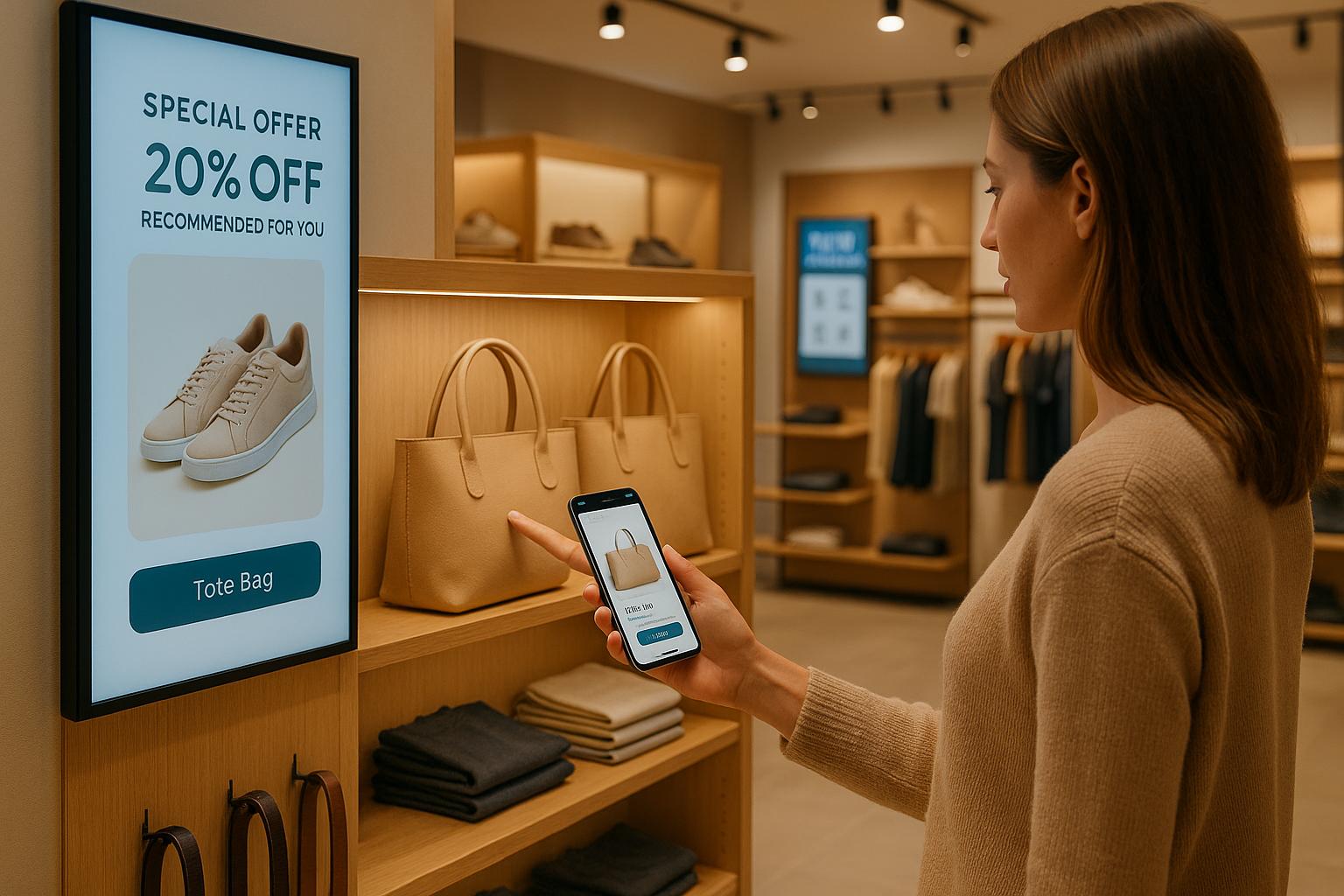
Omnichannel personalization connects online and in-store shopping to create a unified customer experience. It combines AI-powered tools, integrated loyalty platforms, and real-time inventory systems to deliver tailored interactions across all channels. Why does this matter? Because 60–70% of shoppers use both online and offline channels, and these customers are 30% more valuable to retailers over time.
Here’s how it works:
- AI tools analyze customer data for personalized recommendations and real-time assistance, boosting loyalty and sales.
- Loyalty platforms unify rewards and promotions across channels, ensuring consistent customer engagement.
- Inventory systems provide accurate stock data, enabling flexible fulfillment options like buy-online-pickup-in-store (BOPIS).
Retailers using these strategies report:
- 20–30% higher customer satisfaction
- 10–15% revenue growth
- 4% more in-store and 10% more online spending by omnichannel shoppers
The key takeaway? Businesses must integrate data and systems to meet rising expectations for personalized, connected shopping experiences.
Omnichannel Personalization In Action
1. AI-Driven Personalization
AI-driven personalization uses customer data to create tailored experiences at every stage of the shopping journey. The retail sector is seeing a rapid rise in AI adoption, with projections showing growth from $11.83 billion to $54.92 billion by 2033. This surge highlights how AI is bridging the gap between online and in-store shopping, offering more seamless and engaging customer experiences.
Customer Experience
AI transforms how customers interact with brands by delivering real-time, personalized experiences based on behavior and purchase history. Features like visual search, virtual try-ons, and AI-powered chatbots not only enhance confidence but also provide round-the-clock assistance without needing human staff. In fact, 73% of consumers are open to using AI chatbots for customer service, and 87% of shoppers who’ve tried generative AI tools report positive impacts on their shopping experience.
Take Levi Strauss & Co., for example. They’re developing AI-generated models to showcase clothing on various body types, addressing the limitations of traditional product photography. Similarly, cashier-less stores equipped with AI sensors, cameras, and computer vision simplify the shopping process, while smart shelves use AI and IoT technology to monitor stock levels and enhance in-store experiences. But the real game-changer lies in AI’s ability to unify fragmented data sources.
Data Integration
For AI-driven personalization to succeed, it’s essential to consolidate customer data from multiple channels into a unified view. Yet, 70% of businesses face challenges in data integration, with privacy and security concerns being major hurdles. Overcoming these issues can unlock significant advantages.
Sephora shows how it’s done by merging computer vision, augmented reality for virtual try-ons, and a clienteling platform that gives sales staff access to comprehensive purchase histories. This approach has led to a 20% increase in sales for certain products and a 15% improvement in customer loyalty.
A unified customer view can also connect online and offline behaviors using tools like loyalty programs, beacons, QR codes, and mobile apps. For instance, boohooMAN leveraged a Customer Data Platform with predictive analytics to personalize SMS campaigns, achieving a 5x ROI in the UK and a 25x ROI for birthday campaigns. Companies that integrate these channels often see a 20–30% boost in customer satisfaction and a 10–15% rise in revenue. With integrated data in place, AI platforms can efficiently scale these tailored interactions.
Scalability
AI personalization scales effortlessly by processing massive amounts of data and delivering individualized experiences to millions of users at once. Cloud-based AI systems dynamically adjust their resources to handle high-traffic periods, such as during sales events or product launches, making this technology accessible to businesses of all sizes. Additionally, machine learning improves data processing efficiency by 20% and enhances sales forecast accuracy by 25%.
Automation also reduces the need for manual oversight. For example, companies using AI to personalize email campaigns see a 41% increase in click-through rates. Automated audience segmentation combined with A/B testing can lead to a 20% lift in conversion rates. U.S.-based retailer Now Optics uses AI for customer segmentation and dynamic messaging, achieving a 5–10% increase in open rates and a 0.1–2% boost in click-through rates, all while easing the workload for creative and CRM teams. By streamlining operations, scalable AI not only enhances customer experiences but also drives loyalty and revenue growth.
Impact on Loyalty and Sales
AI-powered personalization has a direct influence on customer loyalty and sales by delivering targeted campaigns and relevant product recommendations. Retailers using AI for targeted campaigns have seen a 10–25% increase in return on ad spend, and over 50% of shoppers value AI-driven personalized recommendations when shopping online.
A Bain survey found that 45% of shoppers don’t mind sponsored ads if they’re relevant, and 40% find them helpful during their shopping journey. MAC Cosmetics is a prime example, achieving a 20.56% add-to-cart rate, a 2.3% conversion rate, and a 123.5% increase in homepage conversions with AI-powered Smart Recommender technology, delivering a 17.2x ROI.
Personalization also strengthens long-term customer relationships. According to a survey, 62% of business leaders view customer retention as a key benefit of personalization, while nearly 60% see it as an effective tool for acquiring new customers. Additionally, over half of European shoppers (51%) say a personalized experience increases their likelihood of becoming repeat buyers.
"Personalizing the shopping experience is one of the keys to taking advantage of that affinity and growing any retail business’s customer base. AI will be one of the driving forces behind maximizing personalization and changing the face of retail as we know it today." – Jessica Wong, Founder and CEO of Valux Digital
Even operational tasks benefit from AI. L’Oréal, for instance, uses generative AI to automate the tagging of 200,000 titles across 36 brands and 500+ websites, saving 120,000 hours of manual work while boosting search engine visibility. This highlights how AI-driven personalization delivers value far beyond just increasing sales.
2. Integrated Loyalty Platforms (e.g., Meed)

Integrated loyalty platforms bring together in-store and online experiences, creating a seamless connection across all customer touchpoints. Unlike older, single-channel loyalty programs, these platforms enable brands to provide consistent and personalized interactions, whether customers are shopping online, in-store, or through a mobile app.
Customer Experience
Modern loyalty platforms are reshaping how brands engage with their customers by unifying online and offline interactions. Take Sephora, for instance. The beauty retailer allows customers to start their shopping journey online and continue it in-store, all while maintaining their loyalty status and preferences. They’ve even incorporated features like augmented reality for virtual product trials and social media engagement to enhance the experience.
Starbucks takes a mobile-first approach, letting loyalty members earn, redeem, and track rewards effortlessly across all channels. Whether you’re ordering through the app or visiting a store, the experience remains seamless.
The North Face has gone a step further by rewarding not just purchases but also lifestyle activities. Through their app, customers can earn points by checking in at national parks, which also provides personalized gear recommendations based on their outdoor adventures.
Similarly, Costa Coffee simplifies the customer journey by allowing app users to place orders for in-store pickup, skipping the line entirely. Their app also offers access to order history and tailored loyalty perks, ensuring a personalized experience every time.
These examples show how integrated platforms elevate customer interactions while laying the groundwork for robust data integration.
Data Integration
The backbone of effective omnichannel personalization is unified customer data. Integrated loyalty platforms pull information from every touchpoint to create a single, detailed customer profile. This ensures that loyalty benefits and statuses are recognized consistently, no matter how or where a customer interacts with the brand.
Target is a great example of this. Their loyalty program offers members 1% back on every purchase, whether online or in-store. The program is tightly linked to the Target mobile app, which uses customers’ complete shopping history to provide personalized deals.
Modern platforms like Meed tackle integration challenges with API-first designs. These systems connect seamlessly with existing tools, unifying customer data across channels while also prioritizing data security and privacy. Integration with digital wallets like Apple and Google further reduces friction at checkout.
Once customer data is unified, the next challenge is ensuring the system can scale to meet growing demands.
Scalability
Scalability is critical for loyalty platforms, especially as they grow to handle millions of customer interactions. For example, a global fashion retailer operating in 65 countries deployed a loyalty program capable of handling over 1,500 concurrent API calls, with response times under one second. This was made possible by leveraging cloud-based infrastructure like AWS and Kubernetes.
"Global brands know that the performance of a loyalty program is not only about the number of customers in the database. From a technical point of view, it’s more about the number of concurrent API calls and easy scalability of the system."
– Cezary Olejarczyk, CTO, Open Loyalty
A phased rollout strategy often ensures success, allowing companies to test and refine their systems in controlled environments before scaling up. This approach helps identify and fix performance bottlenecks, ensuring the platform can handle peak traffic without sacrificing the customer experience. Considering that 60% of U.S. consumers are willing to pay for loyalty memberships if they offer exclusive perks, scalability becomes even more crucial.
Impact on Loyalty and Sales
Unified loyalty platforms don’t just improve customer experience – they also drive tangible business results. Omnichannel customers spend 4% more in-store and 10% more online compared to single-channel shoppers. Brands that implement unified customer experience strategies retain 89% of their customers, and McKinsey research shows that omnichannel shoppers make purchases 1.7 times more frequently than their single-channel counterparts.
Platforms like Meed amplify these benefits with features like analytics dashboards that track key metrics such as customer retention, redemption rates, and repeat purchases. Tools like digital stamp cards and QR code rewards encourage frequent engagement, while multi-location support ensures consistency across stores.
Thanks to their scalable design, businesses can start small and gradually expand their loyalty programs. Features like AI-powered receipt scanning and partnerships with external ecosystems help reduce operational costs while boosting customer interaction across all channels.
sbb-itb-94e1183
3. Real-Time Inventory and Order Management Systems
Real-time inventory systems are the backbone of omnichannel shopping experiences, providing accurate data on product availability, pricing, and fulfillment. These systems ensure that customers – whether shopping online, in-store, or through mobile apps – are met with reliable information, creating a smooth and cohesive experience. Combined with AI and loyalty platforms, they form a solid foundation for delivering a unified customer journey.
Customer Experience
Today’s shoppers expect a seamless experience across digital and physical channels. Real-time inventory systems make this possible by offering precise stock details and flexible options like buy-online-pickup-in-store (BOPIS). This not only builds trust but also boosts customer confidence in the brand.
The results speak for themselves. Retailers leveraging these systems have reported up to 40% higher in-store conversion rates, alongside increased average order values and reduced inventory losses. Integrating real-time inventory data across all platforms ensures that customers enjoy a consistent and streamlined shopping experience.
"My favorite thing about using Shopify POS is that it’s simple and easy to use. I can easily train all my staff to use Shopify. I can manage products, run reports, and keep a pulse on my business myself."
– Erica Tucker, Founder of Sweet E’s Bake Shop
Data Integration
For a truly personalized omnichannel experience, real-time inventory systems must connect seamlessly with other business tools. However, this integration is not without its challenges. Synchronizing data across platforms like e-commerce websites, POS systems, CRM tools, and inventory management software can be tricky. Issues such as data silos or compatibility problems can lead to errors in product availability and pricing, ultimately affecting customer satisfaction and operational efficiency.
| Challenge | Solution |
|---|---|
| Data Inconsistency | Errors in stock or pricing can disrupt the customer experience. |
| System Compatibility | Integrating systems often requires specialized APIs to ensure smooth communication. |
| Security Concerns | Weak links in one system can compromise the security of the entire network. |
A great example comes from Bared Footwear, an Australian brand that overcame these hurdles by switching to Shopify Plus and Shopify POS. This move provided accurate inventory data across all locations and ensured uninterrupted operations during major sales events.
"Having all our tooling and commerce data unified in a single platform was a real driving factor. All our sales channels display the same stock availability, and we can run a promotion online and in-store concurrently without worrying about overselling."
– Alexandra McNab, COO of Bared Footwear
Retailers can address these challenges by using middleware or APIs to facilitate smooth communication between systems. Advanced technologies like RFID and IoT sensors further enhance inventory accuracy by providing real-time updates as products move through the supply chain. Automated order management systems have also been shown to cut processing times by 40%.
Scalability
As businesses grow, their inventory and order management systems must keep up with increasing transaction volumes while maintaining accuracy and performance. These systems need to handle real-time updates for numerous SKUs, locations, and sales channels. With 67% of customers starting their shopping journey on one device and completing it on another, syncing data across channels becomes even more critical.
Kenny Flowers offers a compelling example of scaling successfully. As the brand expanded from an online-only presence to include physical retail, its integrated platform ensured a smooth transition.
"Shopify has evolved with us…When we expanded into physical retail, everything worked together as one unified system – from inventory to loyalty rewards to customer data. That’s what makes it special. We can focus on serving our customers, not managing separate systems."
– Kenny Haisfield, Founder of Kenny Flowers
To manage growth effectively, businesses are turning to cloud-based infrastructures and API-first architectures. These solutions allow for the addition of new channels, locations, or product lines without overhauling the entire system. Scalable platforms also enable more precise personalized offers and rewards, enhancing the customer experience.
Inventory shrinkage remains a costly issue, with U.S. retailers losing a staggering $94 billion in 2024 alone. Scalable systems that integrate real-time data can help mitigate these losses while supporting business growth.
Impact on Loyalty and Sales
Real-time inventory and order management systems play a crucial role in making loyalty programs more effective. By providing accurate data, these systems enable personalized offers and smooth reward redemptions. Retailers can identify customer favorites, guiding restocking decisions and shaping promotional strategies.
Take Goodwill Southern New England‘s Club Blue loyalty program as an example. In April 2025, members earned points for every $15 spent, with 15 points redeemable for a 25% off coupon. Real-time inventory data ensured that promotional emails were sent when stock was available, maximizing the program’s impact.
The financial benefits are hard to ignore. Existing customers are 50% more likely to try new products and spend 31% more on average. Even a 5% improvement in customer retention can boost profits by 25% to 95%. Hick’s Nurseries‘ Advantage Rewards Program highlights how accurate inventory data can enhance loyalty initiatives. By ensuring that member-only discounts and seasonal promotions align with stock levels, the program strengthened engagement and drove sales.
Modern systems also streamline operations, reducing administrative workloads and freeing up employees to focus on customer service. This not only improves efficiency but also fosters stronger customer relationships, further enhancing loyalty program success.
Advantages and Disadvantages
This section dives into the strengths and challenges of AI, integrated loyalty platforms, and real-time systems, all crucial for modern retail strategies. While these tools offer impressive benefits, they also come with operational and financial hurdles that retailers need to consider.
AI-driven personalization has proven to be a game-changer. For example, 80% of customers are more likely to engage with businesses that provide tailored experiences. AI can also reduce forecast errors by up to 30% and cut stockouts by 40%. However, the technology isn’t without its downsides. Implementation can be expensive, with nearly half of sellers experiencing losses of up to $1 million during deployment. Additionally, AI requires a high level of technical expertise to manage effectively.
Integrated loyalty platforms, such as Meed, offer a streamlined way to implement omnichannel personalization. These platforms save time and reduce costs, providing features that most retailers can’t develop on their own. When done right, personalization programs can boost revenue by 10–15%. On the flip side, businesses may face challenges like forming dependencies on third-party platforms and navigating the complexities of adoption.
Real-time inventory systems play a vital role in maintaining consistent customer experiences by ensuring products are available across all channels. While these systems help optimize stock levels, integrating them across multiple channels can be a daunting task.
Together, these technologies help create the cohesive customer journey discussed earlier. Omnichannel shoppers, for instance, are up to 30% more valuable and shop 2.5 times more frequently than those using a single channel. However, there’s a catch: 71% of consumers now expect personalized experiences, and 76% report frustration when businesses fail to deliver.
To meet these expectations, automation in areas like supply chain management, marketing, and customer communication is increasingly essential. Retailers must also refine their demand forecasting by channel and establish clear rules for inventory prioritization. Without these measures, the benefits of omnichannel personalization can quickly unravel, leading to operational headaches and unhappy customers.
Companies like Ahold Delhaize, which operates 6,700 stores worldwide, show that large-scale adoption is possible when paired with the right tech partners. And with AI projected to contribute $13 trillion to the global economy by 2030, early adopters have a unique opportunity to gain a competitive edge – despite the upfront challenges and costs involved. These efforts are critical for delivering the seamless omnichannel experiences that today’s customers expect.
Conclusion
Companies that prioritize omnichannel personalization are setting themselves up for success. Just consider this: 51% of e-commerce executives report seeing over 300% ROI from using multi-touchpoint personalization, and omnichannel retailers retain 91% more customers compared to their counterparts.
This success comes from blending three essential technologies seamlessly: AI-driven personalization, integrated loyalty platforms, and real-time inventory management. AI helps businesses understand customer behavior and anticipate their needs. Loyalty platforms, like Meed, create smooth and engaging customer experiences. Meanwhile, real-time inventory systems ensure customers can find and purchase what they want, when and where they want it.
The numbers don’t lie – companies leading in personalization are 71% more likely to report stronger customer loyalty. Personalization marketing can also slash customer acquisition costs by up to 50%. Plus, 78% of customers say they’re more likely to become repeat buyers when they receive personalized content. These figures highlight how crucial it is to have a well-rounded personalization strategy in place.
To succeed, businesses need to approach omnichannel personalization as a unified strategy rather than a collection of separate efforts. Start by mapping out key customer touchpoints and building a comprehensive data strategy. After all, 88% of customers say they value a brand’s experience just as much as the products it offers.
FAQs
How does AI-driven personalization enhance both online and in-store shopping experiences?
AI-powered personalization transforms shopping by customizing product recommendations, search results, and promotions based on a shopper’s preferences, past purchases, and behavior. This approach makes interactions more relevant and engaging, which often leads to higher customer satisfaction, stronger loyalty, and better conversion rates.
On the business side, AI supports retailers by predicting demand, streamlining inventory management, and optimizing staffing. When these insights are applied effectively, companies can deliver a seamless and tailored experience across both online platforms and physical stores.
What obstacles do businesses face when integrating data for omnichannel personalization, and how can they address them?
When businesses aim to deliver personalized experiences across multiple channels, they often face obstacles like data silos, inconsistent data formats, outdated technologies, and even resistance to change. These challenges can disrupt their ability to offer a unified and seamless customer experience.
One effective way to tackle these issues is by adopting a Customer Data Platform (CDP) or similar unified data solutions. These tools help centralize and integrate data in real time, breaking down silos and ensuring a more streamlined approach. Additionally, standardizing data formats and fostering collaboration between departments are crucial steps toward smoother integration. By addressing these roadblocks, businesses can deliver consistent and tailored experiences across both physical and digital touchpoints.
How do real-time inventory systems improve customer satisfaction and streamline operations in omnichannel retail?
Real-time inventory systems are a game-changer when it comes to improving the shopping experience. By providing accurate, up-to-the-minute information on product availability, they help ensure customers can find what they need, whether shopping in-store or online. This reduces frustrating stockouts, speeds up order fulfillment, and delivers a smoother, more dependable experience for shoppers.
From the business side, these systems are just as impactful. They allow retailers to fine-tune stock levels, simplify supply chain operations, and better predict customer demand. By avoiding overstock or shortages, companies can save money, eliminate unnecessary delays, and boost overall efficiency. This kind of integration builds customer trust and loyalty, offering a consistent and dependable experience no matter where or how people shop.