
Loyalty promotions are designed to boost customer spending and foster long-term purchasing habits. But how effective are they? Here’s what you need to know:
- Short-Term Impact: Promotions like discounts, points programs, and limited-time offers can lead to immediate sales increases. For instance, customers in short-term programs spend 9%-17% more on average.
- Long-Term Effects: Retention is key. Over 80% of a loyalty program’s success comes from reducing customer attrition rather than increasing purchase frequency.
- Customer Behavior: Light and moderate buyers respond best to loyalty programs, while heavy buyers show minimal changes in spending habits.
- Generational Preferences: Younger shoppers (Gen Z, Millennials) prefer personalized, gamified experiences, while older customers value straightforward rewards like cash back or discounts.
- Key Metrics: Track Customer Lifetime Value (CLV), redemption rates, and Share of Wallet (SOW) to measure program success effectively.
Loyalty programs can drive both immediate and lasting results, but their success depends on understanding customer behavior, tailoring promotions to specific groups, and leveraging data to refine strategies.
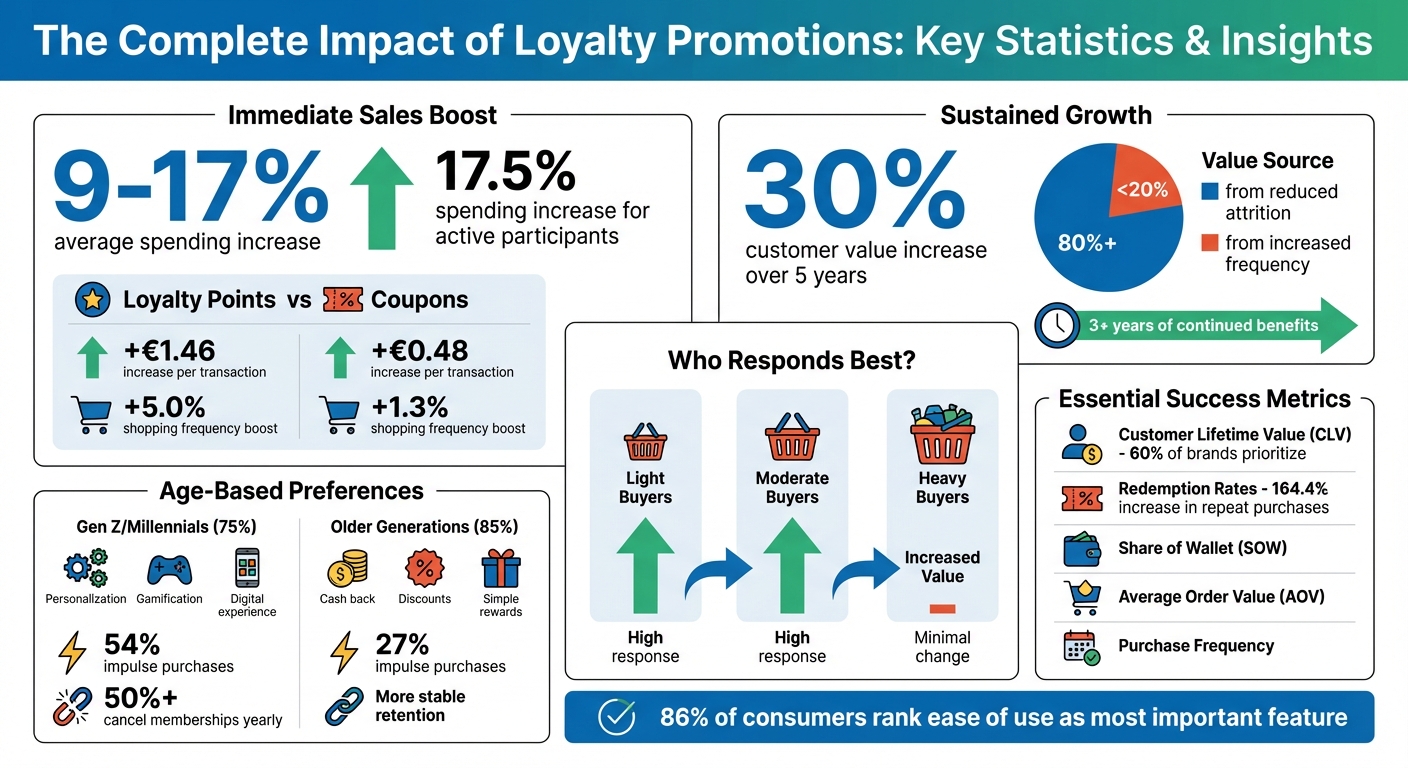
Loyalty Program Impact: Short-Term vs Long-Term Results and Customer Behavior Statistics
Short-Term Effects of Loyalty Promotions
Sales Increases During Promotions
Loyalty promotions often lead to noticeable spikes in sales. For example, customers participating in short-term rewards programs tend to spend an average of 17.5% more, with active participants seeing their sales increase by 9%–17%.
A study conducted on a major German grocery chain revealed that when customers redeemed loyalty points, their average spending increased by €1.46 per transaction. In contrast, coupon redemptions only added €0.48. Moreover, loyalty point redemptions also encouraged a 5.0 percentage point increase in shopping frequency, compared to a 1.3-point rise for targeted coupons.
In 2018, Billa, a Czech supermarket chain, launched an 8-week promotion where customers who collected 15 stamps (equivalent to €120 in spending) could purchase a Disney-themed glass for just €0.80 – offering a discount of over 90%. Similarly, Lowes Foods in the U.S. ran an 18-week program where shoppers earned one stamp for every $10 spent. Collecting 50 stamps ($500 in spending) allowed customers to purchase premium cookware at discounts of up to 95%.
These promotions highlight how loyalty programs can drive immediate sales by tapping into customer behavior.
What Drives Immediate Customer Response
Three main factors explain why customers respond so quickly to loyalty promotions:
- Points Pressure: When customers know a promotion is ending soon, they feel a sense of urgency to spend more in order to hit the reward threshold before the deadline.
"The shorter, finite horizon of the program makes the points pressure mechanism more imperative for temporary programs than with regular, continuous LPs".
- Redemption Momentum: Spending tends to increase both before and after customers redeem rewards. Just the act of redeeming – even a small portion of their points – can significantly boost their purchase behavior.
"The mere decision to redeem a reward significantly enhances purchase behavior before and after the redemption event, even when members redeem just a fraction of their accumulated points".
- Set Completion Effect: Customers are often motivated to complete a collection, whether it’s cookware, collectible toys, or other themed items. This drive to "complete the set" encourages additional spending that might not have occurred otherwise.
These behavioral triggers illustrate how loyalty promotions can effectively encourage short-term spending, while also revealing the psychology behind customer decisions.
Long-Term Effects on Customer Buying Habits
Continued Purchase Patterns
Loyalty promotions may generate quick sales surges, but their real value lies in the long game. Non-tiered loyalty programs, for example, have been shown to increase customer value by nearly 30% over a five-year period. Unlike short-term strategies that focus on boosting spending per visit, long-term success hinges on keeping customers engaged and coming back.
Take Dominick’s Finer Foods’ "Fresh Values" frequent shopper card as an example. While it initially drove up sales and profits, the gains were fleeting as customers shifted their spending across categories. This highlights a critical lesson: loyalty programs should prioritize retention over short-term revenue spikes. Consistent growth comes from encouraging planned purchases rather than relying on impulse buys.
The most effective programs create what researchers call a "lock-in effect." By offering delayed rewards or requiring membership renewals, these programs keep customers invested and purchasing even after they’ve achieved their initial goals. Categories with a strong share of private-label products often experience more stable growth in both sales and profits after launching loyalty programs. This approach not only drives revenue but also strengthens customer retention and reduces attrition over time.
Customer Retention and Repeat Purchases
Loyalty programs do more than just boost spending – they create a foundation for long-term customer commitment. In fact, over 80% of the value generated by loyalty programs comes from reducing customer attrition, while increased purchase frequency accounts for less than 20%.
"The program’s reduction in attrition accounts for over 80% of the program’s total lift, while increased frequency accounts for less than 20% of the program’s lift." – Arun Gopalakrishnan et al., Researchers
Interestingly, the impact of loyalty programs varies depending on a customer’s buying habits. Light and moderate buyers show the most potential for change. They often increase how often they shop and begin exploring new product categories. By contrast, heavy buyers tend to redeem rewards without significantly altering their purchasing patterns. Research on multi-vendor loyalty programs further supports this, showing that while these programs reduce the time between purchases, they don’t have a major effect on how much customers spend per transaction. The retention benefits, however, can last for at least three years after the program is introduced.
How Different Age Groups Respond to Loyalty Programs
Gen Z and Millennials: Personalized Experiences
For Gen Z and Millennials, loyalty programs need to go beyond basic discounts. A whopping 75% of this group expects tailored, seamless digital experiences. They’re drawn to programs that offer exclusive content and rewards matching their personal preferences.
Interestingly, younger shoppers are more likely to make impulse purchases as loyalty members – 54% of Millennials and 53% of Gen Z compared to just 27% of Baby Boomers. They also place high value on member communities and gamification, with over 50% appreciating these features, unlike less than 20% of older consumers.
Wendy’s tapped into this trend in 2023 by launching an AI-driven platform across North America. Using data from its app and customer database, the platform creates personalized offers and incorporates gamification to keep younger customers engaged. Similarly, Sephora’s "Beauty Insider Community" has drawn 17 million registered members who participate in challenges, share beauty tips, and build emotional connections beyond just shopping.
However, loyalty from this group can be fleeting. More than 50% of consumers aged 18 to 34 plan to cancel at least some of their loyalty memberships within the next year. They’re also over twice as likely as older generations to jump ship to a competitor’s program.
On the other hand, consumers aged 35 and older tend to prefer a different approach.
Older Generations: Simple and Direct Rewards
Older generations are all about simplicity and clarity when it comes to loyalty programs. A significant 85% of U.S. consumers prioritize points, cash back, and promotions as their top benefits. Unlike younger consumers who enjoy app-based features and gamified experiences, older shoppers prefer programs that are straightforward and easy to navigate. They value rewards that are simple to redeem and avoid digital complications. In fact, fewer than 50% of Baby Boomers consider a seamless digital experience essential, compared to over 75% of younger consumers.
"Financial rewards alone are no longer enough to capture and keep the attention of increasingly selective consumers." – Bobby Stephens, Principal, Deloitte Digital
Despite this observation, older customers remain primarily motivated by tangible financial benefits. They also show less inclination toward impulse buying within loyalty programs. Additionally, they are less likely to cancel memberships or switch to competitors, making them a more stable customer base.
Recognizing these generational preferences is crucial for designing loyalty programs that resonate with each group, ensuring both immediate appeal and long-term engagement.
sbb-itb-94e1183
Using Data to Track Purchase Trends
Important Metrics to Track
If you’re serious about measuring the success of your loyalty program, there are a few key metrics you need to keep an eye on. Customer Lifetime Value (CLV) is a big one – it tells you how much revenue a customer generates over their entire relationship with your business. Then there’s Average Order Value (AOV), which shows how much customers typically spend per transaction. Another important metric is purchase frequency, which helps you understand how often customers come back to shop.
Pay close attention to redemption rates, too. These rates give you a clear picture of how engaged your customers really are. Businesses that track customers who actively redeem rewards often see impressive results: a 164.4% increase in repeat purchase rates and an 88.5% boost in average revenue per customer compared to those who don’t redeem.
Another valuable metric is Share of Wallet (SOW), which measures how much of a customer’s spending in your category goes to you instead of your competitors. This metric gives you a deeper insight into loyalty beyond just transaction numbers. And don’t forget about "breakage" – the percentage of loyalty points that expire without being used. High breakage rates, especially among your top customers, can indicate that your program isn’t hitting the mark.
These metrics are the building blocks for smarter, data-driven decisions.
Using meed for Analytics
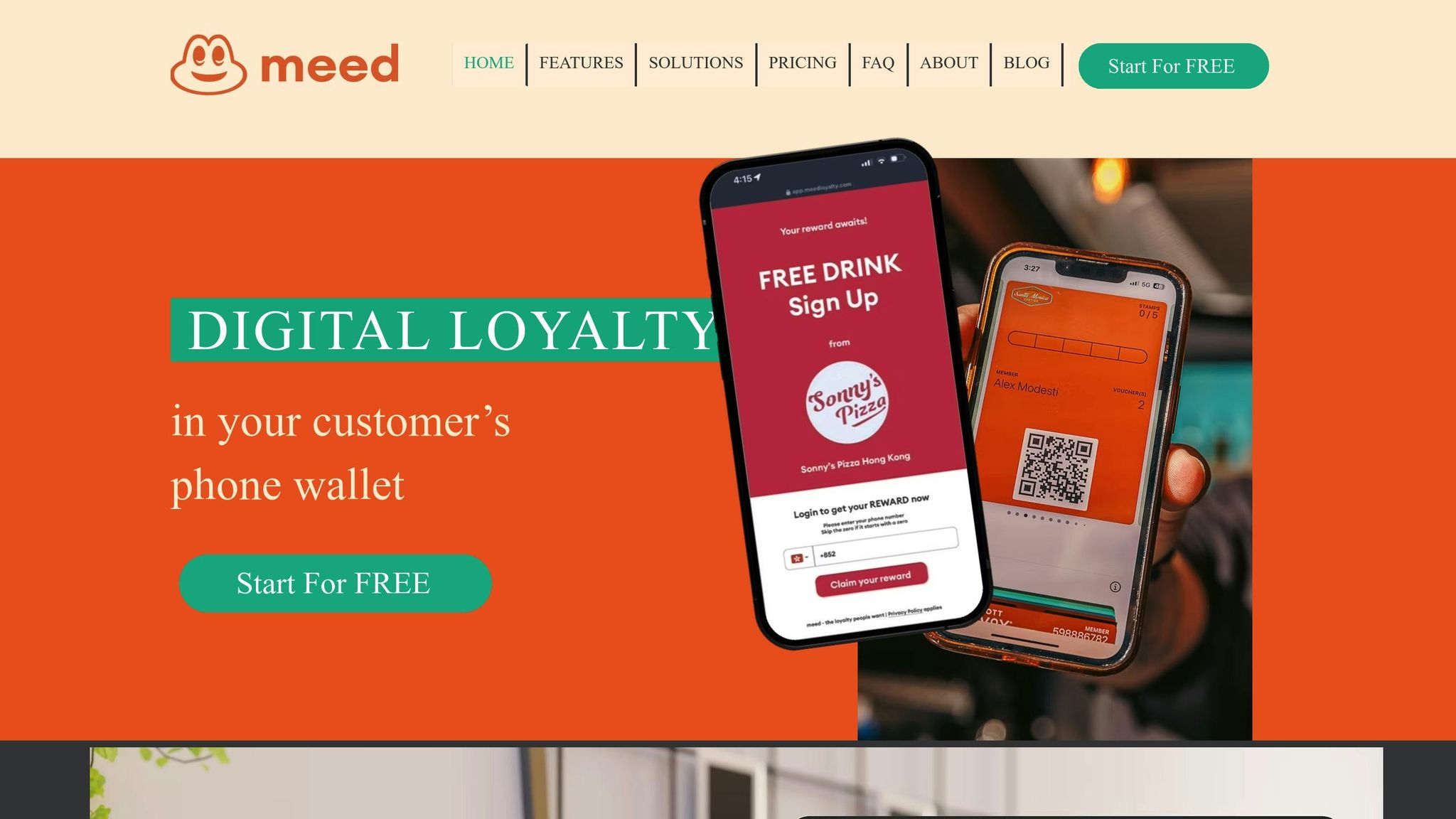
The meed analytics dashboard makes tracking these critical metrics simple – even if you’re not a data expert. It provides real-time insights into redemption patterns, purchase frequency, and customer behavior, helping you identify trends as they happen.
One standout feature is its AI-powered receipt scanning. This tool automatically captures transaction data, eliminating the risk of manual entry errors. By leveraging machine learning, meed analyzes purchase histories and engagement patterns, giving you the ability to anticipate customer needs with precision. With 60% of brands now prioritizing CLV as their go-to metric, having access to this kind of data isn’t just helpful – it’s essential. The platform even pinpoints customers who are close to earning rewards or showing signs of disengagement, so you can step in and take action before it’s too late.
Conclusion
Summary of Immediate and Lasting Effects
Loyalty promotions deliver a dual benefit: they create immediate sales surges while building long-term customer loyalty. In the short term, customers often feel "points pressure" as they near reward milestones, prompting quicker purchases. But the real magic happens over time. Studies reveal that introducing a loyalty program can boost sales and gross profits within the first year, with these benefits continuing for at least three years. Interestingly, over 80% of this growth comes from reduced customer attrition, while less than 20% is tied to increased visit frequency. This underscores the critical role of retention over short-term spending spikes.
That said, it’s important to keep an eye on trends after promotions end. Some businesses notice a temporary dip in purchase frequency post-campaign. Understanding these patterns is key to crafting better strategies moving forward.
Practical Steps for Businesses
With these insights in mind, businesses should focus on refining their loyalty strategies. Retention should be the top priority. Since most of a program’s value comes from keeping customers engaged, promotions should aim to reduce attrition rather than simply encouraging larger transactions. Research shows that personalized coupons can generate three times more incremental revenue than generic loyalty rewards.
Customer segmentation is essential. Group customers based on their buying habits and recency of purchases. Light and moderate buyers often respond most positively to loyalty programs, so tailor your promotions to this group for maximum impact. Use real-time data to adjust your approach as customer behaviors shift. Simplicity is also crucial – 86% of consumers rank ease of use as the most important feature in a loyalty program. A clear, straightforward program will always outperform one that confuses participants.
Lastly, make the most of your analytics tools. Track metrics like redemption rates, purchase frequency, and customer lifetime value in real time. Platforms like meed can simplify this process by automatically collecting transaction data and flagging customers who are nearing rewards or showing signs of disengagement. Acting on these insights quickly allows you to send targeted offers, re-engage customers, and maintain steady business growth.
How to design DTC loyalty programs with AI | Nathan Snell | Raleon
FAQs
What strategies ensure long-term success for loyalty programs?
To build lasting success, businesses should view loyalty programs as more than just a way to hand out rewards – they’re powerful tools for strengthening customer relationships. Start by defining specific goals that align with your brand’s objectives, like minimizing customer churn or boosting how often people shop with you. To keep customers interested while protecting your bottom line, offer a mix of appealing rewards, such as discounts, cashback, or tailored experiences.
The structure of your program matters just as much. Features like tier-based rewards, timely delivery of benefits, and clear expiration rules can make your program feel more valuable and encourage customers to redeem their rewards. Shifting your focus to building long-term customer loyalty, rather than simply driving quick sales, can lead to a noticeable increase in customer lifetime value.
Leveraging a universal loyalty platform, like Meed, can make managing your program easier while enhancing customer engagement. With options like digital stamp cards, QR-code-based rewards, and wallet integrations, businesses can create personalized campaigns that are both convenient and engaging for customers. This streamlined approach not only cuts down on administrative tasks but also ensures your loyalty program keeps up with evolving customer expectations.
What are the key metrics to measure the success of loyalty program promotions?
To measure the success of loyalty program promotions, focus on metrics that capture both short-term gains and long-term customer behavior. Start with incremental revenue, which shows the extra sales generated beyond your usual baseline. Pair this with average order value (AOV) during the promotion to gauge how much customers are spending, and analyze the redemption rate to see how many rewards are actually being used. Together, these metrics provide a clear picture of the promotion’s financial impact and customer engagement.
For a deeper dive into customer loyalty, track metrics like repeat-purchase frequency, customer lifetime value (CLV), and sales or profit lift. These indicators help reveal whether promotions are driving lasting changes in shopping habits and delivering a strong return on investment. You can also look at behaviors like increased shopping visits or app interactions to understand how promotions are shaping customer habits over time.
Tools like meed can make this process easier by consolidating all these metrics into real-time dashboards. This allows businesses to monitor performance seamlessly and fine-tune their loyalty strategies for better results.
How do different generations influence the design of loyalty programs?
Generational preferences significantly influence the design of loyalty programs. Younger shoppers, particularly Gen Z and Millennials, are more inclined to join these programs, often prioritizing digital-first experiences. They’re drawn to features like mobile sign-ups, QR-code rewards, and seamless integration with tools like Apple Wallet or Google Pay. Additionally, rewards that encourage impulse purchases resonate strongly with this group, making fast and interactive reward systems a must for capturing their attention.
On the other hand, Baby Boomers and older generations prefer simple and straightforward benefits. They appreciate loyalty programs with clear point systems, hassle-free redemption processes, and transparent policies. Flashy or overly gamified features aren’t as appealing to this audience. To effectively engage all demographics, loyalty programs should strike a balance – offering dynamic, tech-savvy rewards for younger users while maintaining predictable and easy-to-use benefits for older participants.
Platforms like meed simplify this process by providing tools to design both digital rewards and traditional point-based systems. Plus, it ensures compatibility with U.S. payment methods and wallet integrations, making it easier to cater to the varied preferences of different generations.