
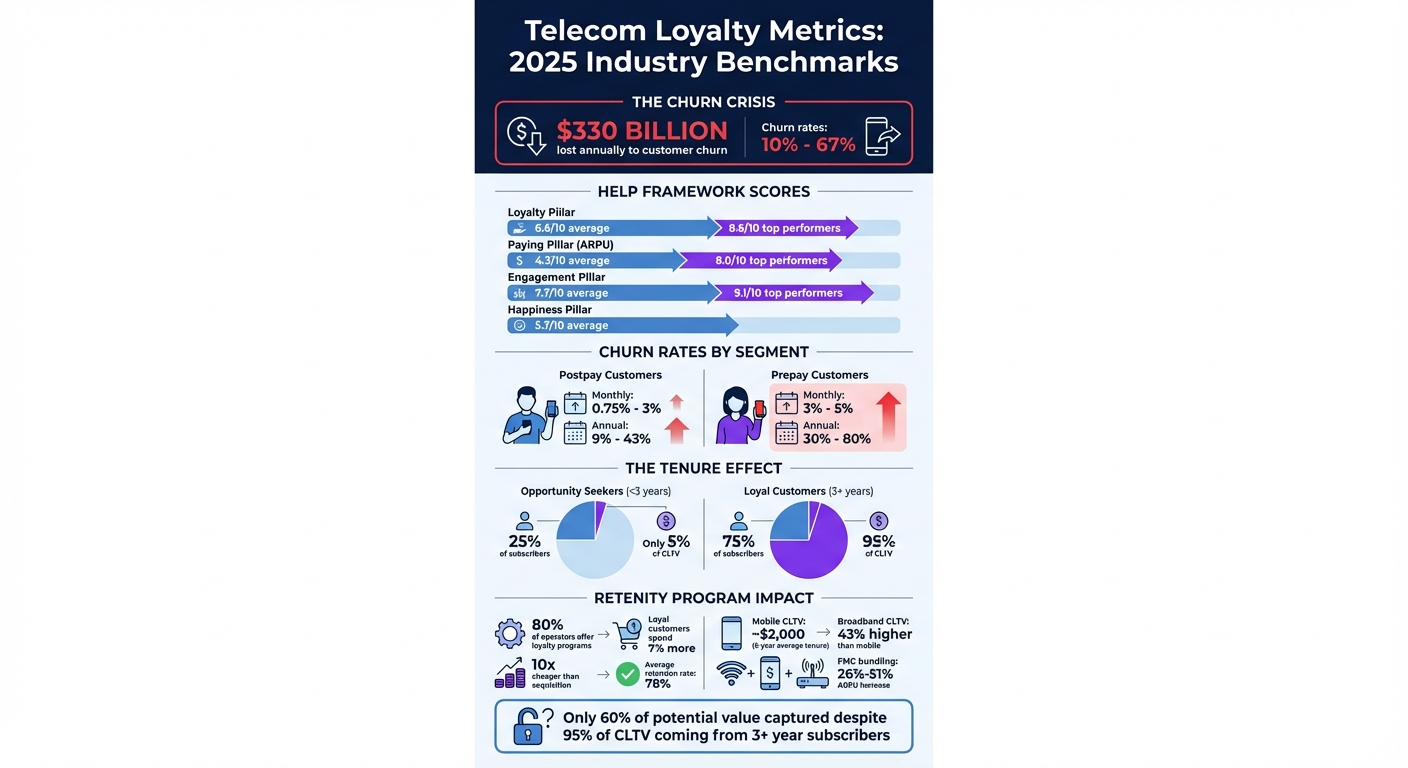
Telecom companies lose $330 billion annually to customer churn, with churn rates ranging from 10% to 67%. Retaining customers is far cheaper than acquiring new ones, and loyalty metrics like churn rate, Customer Lifetime Value (CLTV), and Net Promoter Score (NPS) help providers measure and improve retention efforts. Key findings from 2025 benchmarks include:
- Average churn rates: Postpay customers churn at 9%-43% annually; prepay churn reaches 30%-80%.
- CLTV drivers: Customers staying over three years contribute 95% of CLTV, while loyalty programs boost CLTV by 43%.
- ARPU gap: Top telecom companies achieve nearly double the average ARPU scores (8.0/10 vs. 4.3/10).
- Retention vs. acquisition: Keeping customers costs 10x less than finding new ones, with a 5% boost in retention increasing profits by 25%-95%.
Providers must simplify loyalty program enrollment, personalize rewards, and leverage AI tools to predict churn and enhance engagement. Gamification features like milestone rewards and instant incentives also strengthen customer relationships.
2025 Telecom Loyalty Metrics: Industry Benchmarks and Performance Gaps
Key Industry Benchmarks for Telecom Loyalty
2025 Benchmark Data
Telecom operators rely on the HELP Framework – Happiness, Engagement, Loyalty, and Paying – to evaluate customer value. According to the Simon-Kucher Global Telecommunications Study 2025, the average Loyalty Pillar score, which measures customer tenure, is 6.6 out of 10. However, the Paying Pillar score, reflecting ARPU (average revenue per user), trails at just 4.3 out of 10. This disparity highlights a common issue: providers are better at retaining customers than fully monetizing them.
The gap between average performers and top-tier companies is even more pronounced. While the industry average Loyalty score is 6.6/10, the top 10% of companies hit 8.6/10. Similarly, top performers score 8.0/10 on the Paying Pillar, nearly doubling the average of 4.3/10. The Engagement Pillar shows a stronger average performance at 7.7/10, with leaders reaching 9.1/10. Meanwhile, the Happiness Pillar, assessed through metrics like NPS (Net Promoter Score) and price-value perception, averages a more modest 5.7/10.
Loyalty programs significantly impact customer lifetime value (CLTV), boosting it by 43%. Moreover, customers who actively interact with service touchpoints – such as mobile apps or customer support – exhibit a 19% higher CLTV than those who don’t. These stats emphasize the importance of not only enrolling customers in loyalty programs but also encouraging ongoing engagement.
These benchmarks provide a foundation for exploring variations in CLTV across specific services.
Mobile vs. Broadband CLTV Comparison
Mobile and broadband customers contribute to revenue in distinct ways, reflecting differences in tenure and monetization patterns. For mobile services, CLTV averages around $2,000, driven by an average customer tenure of six years. This longer tenure provides a steady revenue stream.
Broadband customers, on the other hand, deliver 43% higher CLTV than mobile users despite having shorter relationships. This is largely due to higher ARPU, as broadband services often command premium pricing that offsets their shorter customer lifespans. For providers offering both mobile and broadband, fixed-mobile convergence (FMC) strategies can increase ARPU by 26% to 51% through service bundling.
Churn and Retention Benchmarks
Churn Risks by Customer Segment
Churn rates can vary widely depending on the customer segment. For Mobile Network Operators, monthly churn rates typically fall between 0.75% and over 5%. Postpay customers tend to churn at rates between 0.75% and 3% monthly (equivalent to 9% to 43% annually), while prepay customers churn at a higher rate of 3% to 5% monthly (or **30% to 80% annually).
Interestingly, opportunity seekers – those with less than three years of tenure – make up 25% of subscribers but contribute just 5% of the total Customer Lifetime Value (CLTV). These customers often switch providers for promotional offers. In contrast, subscribers with three or more years of tenure account for 75% of the customer base and generate a whopping 95% of CLTV.
High-ARPU (Average Revenue Per User) customers bring a unique challenge. While they are the most profitable segment, they also face the highest risk of churn. Additionally, involuntary churn – often caused by failed payments – results in 15% monthly revenue losses[15].
These insights into segmented churn risks highlight the critical importance of retention strategies, which we’ll delve into next.
Retention vs. Acquisition Costs
The financial impact of churn naturally emphasizes the value of customer retention over acquisition. Retaining an existing customer is 10 times cheaper than acquiring a new one, as acquisition costs can be 5 to 25 times higher. Furthermore, loyal customers tend to spend 7% more than new ones, according to Simon-Kucher.
The average retention rate hovers around 78%, with annual churn rates ranging from 10% to 67%. Even a modest 5% improvement in retention can lead to a 25% to 95% increase in profits. Yet, the challenge remains significant – 33% of broadband customers and 41% of mobile customers plan to switch providers when their contracts end.
Loyalty Program Enrollment and Effectiveness
Enrollment Rates and Barriers
Around 80% of telecom operators provide loyalty programs, but only half of their customers actually enroll in them. The biggest hurdle? A complicated sign-up process. When registration involves lengthy forms or unclear instructions, customers tend to give up. Simplifying this process can make a huge difference. For example, offering one-tap enrollment through mobile apps or automatically enrolling customers when they create an account can significantly improve participation rates. This is especially important since 81% of customers prefer using mobile apps for such interactions.
Another issue is the lack of personalized rewards. Generic discounts that don’t align with individual preferences fail to capture customer interest. In fact, 75% of consumers say they’re more likely to engage with loyalty programs that are easily accessible on their smartphones.
By addressing these barriers, companies can set the foundation for loyalty programs that genuinely enhance customer relationships and drive long-term value.
How Loyalty Programs Increase CLTV
Once enrollment is streamlined, loyalty programs can significantly boost customer lifetime value (CLTV). Studies show that participation in these programs leads to a 43% increase in CLTV. Simon-Kucher highlights this impact:
Participation indicates a 43% uplift in CLTV, making loyalty programs the single strongest customer engagement proxy in our HELP framework.
This increase stems from shifting customer relationships from purely transactional to more emotional connections. For instance, blending practical rewards like bill credits with experiential perks – such as priority customer support, access to exclusive events, or gamification features like progress bars and milestone badges – can enhance engagement by up to 40%. Additionally, offering instant welcome bonuses and personalized rewards can further strengthen customer loyalty.
sbb-itb-94e1183
Emerging Trends in Telecom Loyalty Metrics
Gamification in Loyalty Programs
Gamification is changing the way telecom companies approach customer engagement. Instead of sticking to the traditional points-for-spending model, providers are now focusing on tracking meaningful behaviors like referrals, on-time bill payments, plan upgrades, and participation in eco-friendly initiatives. This shift moves loyalty programs from being purely transactional to fostering deeper, engagement-based relationships.
The success of gamification is measured with more dynamic metrics than before. Companies now track active participation rates, milestone completions, and monthly active users (MAU). A great example is health-tech firm dacadoo, which implemented a gamification engine in 2025. By rewarding participation and monitoring activity levels, dacadoo saw a 62% annual increase in MAU and achieved seven times higher retention rates after 30 days compared to industry norms.
T-Mobile USA takes a different route with its "T-Mobile Tuesdays" app, offering instant rewards like discounts on dining and entertainment. This approach, focused on immediate gratification, has made it one of the most popular loyalty programs in the U.S. telecom industry. In contrast, Telstra in Australia employs a tiered system (Member, Silver, Gold), where customers earn points for every dollar spent. Higher tiers, such as Gold status (achieved by spending $3,000 annually), unlock perks like concert presales and movie tickets.
"In telco, gamification can play a crucial role in making loyalty programs more attractive and engaging for customers on a daily basis… Gamification makes loyalty programs dynamically engaging." – Wojciech Gil, Business Solution Manager, Loyalty at Comarch
These gamification strategies are further enhanced by the use of artificial intelligence, which brings a data-driven edge to customer engagement.
AI-Powered Personalization
While gamification boosts engagement, artificial intelligence takes personalization to the next level. AI leverages real-time data to refine customer interactions, helping telecom providers build stronger loyalty programs. By combining sales, service, and usage data, AI creates a 360-degree customer profile, ensuring consistent and seamless experiences. This is especially critical given that 70% of customers report inconsistencies in service across channels.
The financial benefits of AI-driven personalization are hard to ignore. For instance, AI can deliver context-aware micro-offers, such as a 1-day data pack offered precisely when a customer needs it. This mirrors impulse-buying behavior and drives immediate engagement. Companies like Verizon and SK Telecom are already incorporating generative AI into their mobile apps. These AI-powered super-apps predict customer needs, offer proactive support, and create personalized digital experiences, reducing churn and boosting satisfaction.
"AI isn’t just a tool – it’s a transformation enabler. By analyzing customer behavior in real time, AI empowers CSPs to anticipate needs, deliver tailored solutions, and ensure seamless, omnichannel experiences." – Accenture
The focus on AI-powered metrics aligns with a larger industry shift. 37% of loyalty leaders now prioritize customer retention and Lifetime Value (LTV) as key measures of program success, while 39% focus on financial metrics like ROI. By analyzing early churn signals – such as reduced app usage or changes in payment habits – telecom providers can intervene with personalized offers, keeping customers from switching to competitors.
Conclusion and Next Steps
Key Lessons from Industry Benchmarks
The 2025 benchmarks reveal some eye-opening trends in the telecom industry. Telecom providers are capturing only 60% of their potential value, even though 95% of customer lifetime value (CLTV) comes from subscribers who’ve stayed beyond three years. These long-term subscribers not only stick around but also spend 7% more. However, there’s a glaring gap: only half of these customers enroll in loyalty programs, despite 80% of providers offering them.
Retention proves to be far more cost-efficient than acquisition – up to 10 times cheaper, in fact. Yet, with an average retention rate of 78%, there’s still room for improvement, especially when 67% of customers leave due to poor engagement rather than price. The message is clear: telecom providers need to focus on creating personalized, meaningful experiences that reward loyalty and encourage active participation.
These insights point to three critical areas for improvement: boosting customer tenure, reducing retention costs, and addressing barriers to loyalty program enrollment. A focused and effective loyalty strategy is essential to tackle these challenges.
Building Loyalty Programs with meed
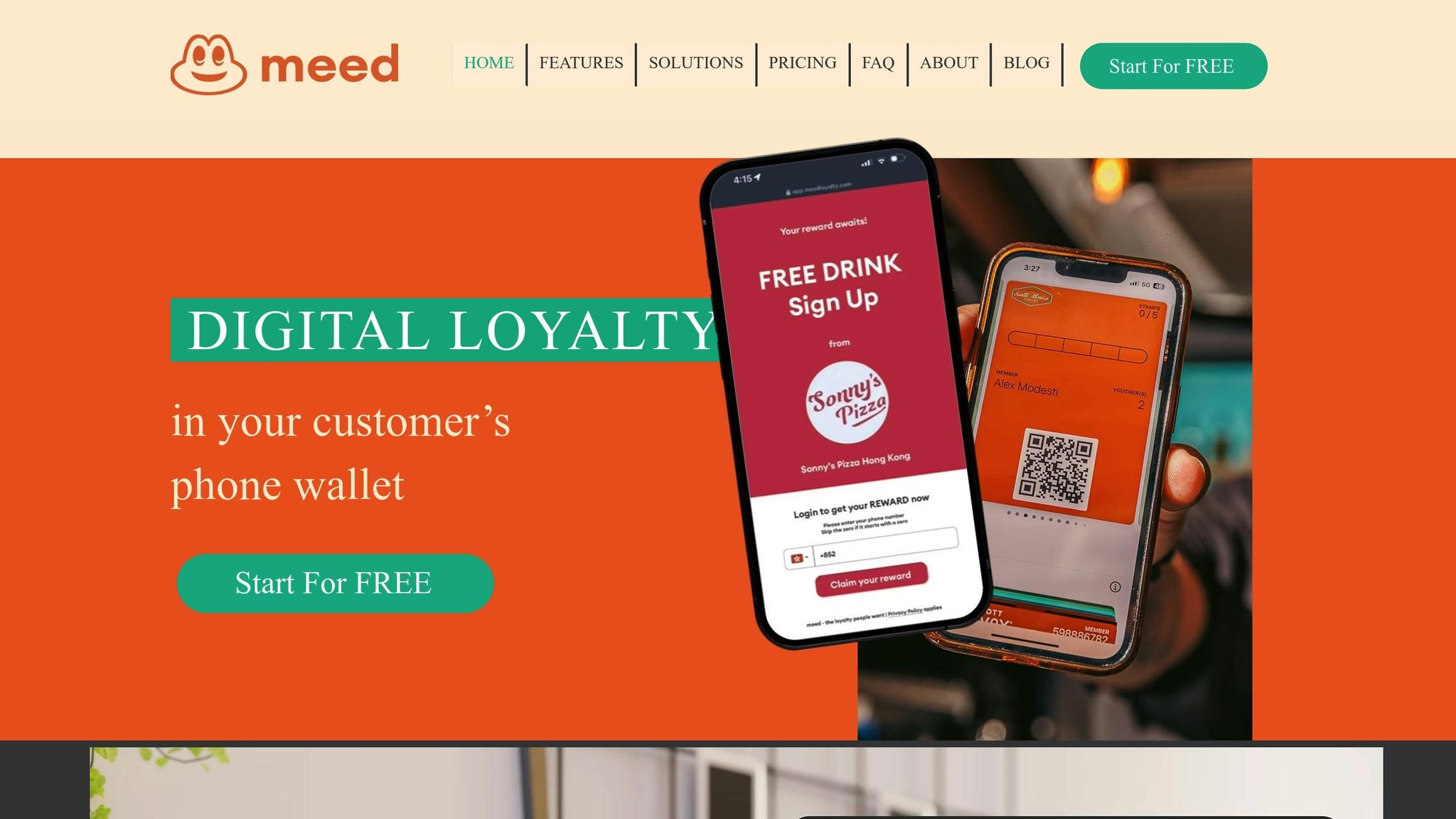
To address these gaps, telecoms can turn to platforms like meed. This ready-to-deploy solution eliminates the high costs and complexities of building in-house systems, offering tools like digital stamp cards, QR code rewards, and seamless integration with Apple and Google wallets.
With a unified dashboard, meed makes it easy to track key metrics such as enrollment rates, redemption behaviors, and customer engagement scores. Businesses can create tiered reward structures to encourage long-term loyalty, launch targeted campaigns for specific customer groups, and use real-time analytics to identify and address churn risks before they escalate. Whether you’re launching your first loyalty program or managing a complex system with multiple layers and touchpoints, meed is designed to scale effortlessly.
The platform’s mobile-first approach is particularly aligned with customer preferences, as 75% of consumers prefer accessing rewards through their smartphones. By making enrollment and redemption straightforward, meed helps telecom providers turn passive, aware customers into active, engaged participants. This shift transforms loyalty programs from a simple discount mechanism into a powerful tool for driving growth and strengthening customer relationships.
Techniques for Tracking Customer Loyalty in 2024 | Measuring Customer Loyalty | TechGrowth Insights
FAQs
How do loyalty programs increase customer lifetime value in the telecom industry?
Loyalty programs play a big role in improving Customer Lifetime Value (CLV) in the telecom industry by tackling churn and opening up new revenue streams. Research highlights that many telecom customers leave due to a lack of engagement, which can hurt future profits. By introducing features like tiered rewards, personalized offers, and gamified experiences, loyalty programs encourage customers to stick around, directly improving their CLV.
Keeping an existing customer is much cheaper than trying to win over a new one. In fact, retention efforts cost significantly less and pack a strong financial punch. For instance, even a modest 5% increase in retention can translate into a 25%-95% boost in profits. On top of that, loyalty programs with personalized touches create opportunities for cross-selling and upselling, pushing up the average revenue per user (ARPU) and further enhancing CLV.
Platforms like meed make managing loyalty programs easier for telecom operators. With tools like digital stamp cards, QR code-based rewards, and wallet integration, they enable businesses to deliver tailored, seamless experiences. These features not only improve retention but also help maximize the long-term value of each customer.
What challenges do telecom companies face when enrolling customers in loyalty programs?
Telecom companies face a tough battle when it comes to getting customers to join loyalty programs. With fierce competition and high customer turnover, it’s no surprise that churn rates in the industry can range from 10% to a staggering 67% each year. Many subscribers don’t stick around long enough to even consider a loyalty program – especially when 67% of them cite poor engagement as a major reason for switching providers.
Another hurdle is the lack of personalization. Customers often feel like just another account number. Generic rewards and one-size-fits-all communications don’t cut it, leaving many unimpressed and uninterested. People want experiences that reflect their individual preferences and usage habits. Without that personal touch, loyalty programs can feel irrelevant. And while telecom companies are generally trusted to keep data secure, that trust doesn’t always translate into customers actively participating in these programs.
One way to overcome these challenges is by implementing a loyalty platform that’s simple, engaging, and user-friendly. meed offers tools like digital stamp cards, QR code-based rewards, and seamless integration with Apple and Google Wallets. These features help telecom businesses deliver personalized, hassle-free experiences that make customers more likely to enroll and stay engaged.
How can AI and gamification improve telecom loyalty programs?
AI and gamification are reshaping telecom loyalty programs by making them more engaging and tailored to individual customers. AI dives into customer data – like usage habits and billing trends – to predict when someone might leave, suggest personalized offers, and deliver rewards that feel custom-made. It can even handle tasks like crafting personalized notifications or powering virtual assistants, making customers feel appreciated while boosting retention and their overall value to the company.
On the other hand, gamification brings an element of fun to everyday actions. Simple tasks like paying a bill or upgrading a plan can become exciting challenges with points, badges, leaderboards, or surprise perks. These features encourage customers to interact more often and even spend more. Together, AI and gamification create a smooth, engaging experience that keeps customers loyal, reduces churn, and helps drive revenue in the competitive U.S. telecom market.