
Loyalty APIs streamline how super apps integrate rewards programs into their platforms. By connecting various services like food delivery, ride-sharing, and payments, these APIs enable real-time point tracking, reward redemption, and tier upgrades. This not only enhances customer engagement but also increases spending and retention. Businesses benefit from automated operations, reduced churn, and valuable data insights for personalized offers.
Key Highlights:
- Boosts Revenue: Loyalty programs increase visit frequency by 23–32% and spending by 20–35%.
- Real-Time Updates: APIs instantly sync transactions, points, and rewards across services.
- Flexible Integration: Headless architecture separates backend logic from user interfaces, allowing seamless loyalty features across apps, websites, and kiosks.
- Advanced Features: Includes geofencing, push notifications, and AI-driven receipt scanning for dynamic rewards.
- Cross-Service Ecosystem: Users can earn and redeem points across multiple services within the app.
For businesses, integrating loyalty APIs means streamlined operations, better customer experiences, and actionable analytics to measure program success. With proper planning, secure implementation, and performance tracking, loyalty APIs can transform how super apps drive growth and customer loyalty.
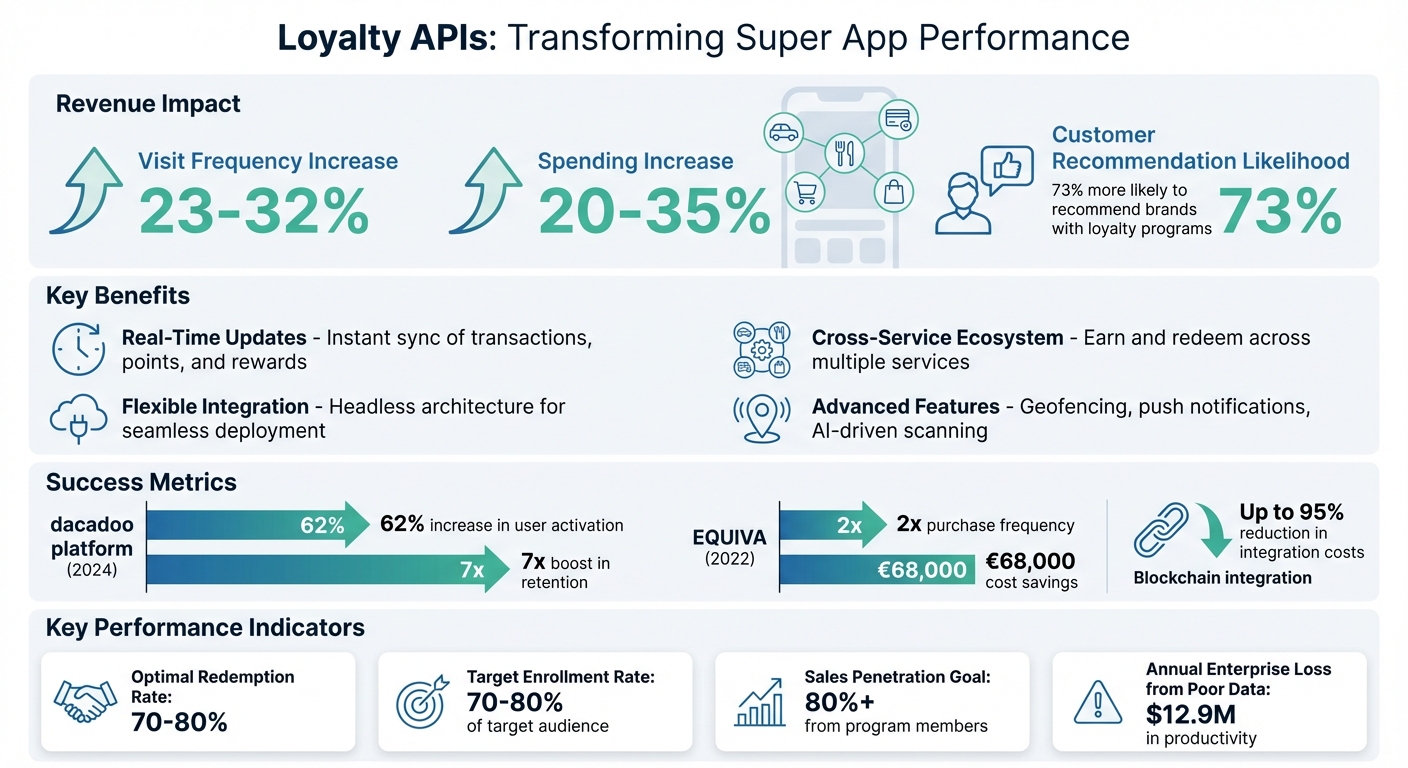
Loyalty API Impact Statistics and Key Performance Metrics for Super Apps
How Loyalty APIs Improve Super App Performance
Smooth Customer Experience
Loyalty APIs separate the front-end user interface from the back-end processes, making it easier to integrate loyalty features like automatic card-linking and AI-driven receipt scanning directly into a super app’s interface. This integration happens without compromising the app’s branding or user experience. Additionally, digital wallets like Apple Wallet and Google Wallet allow users to access loyalty cards instantly, complete with real-time updates. Since these features are opt-in by default, they tend to achieve much higher engagement rates compared to traditional email or SMS notifications. This setup creates a foundation for managing rewards dynamically and in real time.
Platforms such as meed are prime examples of how loyalty API integrations can elevate the customer experience within super apps.
Real-Time Reward Management
Every time a transaction occurs, loyalty APIs work behind the scenes to immediately update point balances, membership tiers, and digital wallet visuals. At the same time, push and webhook notifications deliver timely updates and location-based rewards directly to users. For instance, push notifications might say something like, "You’re 5 points away from a free coffee", keeping users engaged without needing extra permissions. Geofencing APIs can trigger rewards when users are near specific stores, while Events APIs reward non-transactional activities like leaving a review or engaging on social media.
A great example of this in action is the digital health platform dacadoo, which saw a 62% increase in user activation and a sevenfold boost in retention after adding gamified loyalty features through an API in 2024. This kind of instant feedback not only improves user satisfaction but also enables smooth, interconnected functionality across various services within a super app.
Cross-Service Integration
Loyalty APIs help create a unified ecosystem where users can earn points in one service, like food delivery, and use them in another, such as ride-sharing or online shopping. These APIs sync loyalty data with existing systems like CRM, ERP, and CDP platforms, offering a single, comprehensive view of customer behavior across all integrated services. This eliminates the need for users to juggle multiple accounts or apps for different services within the super app.
With Orders API integration, tasks like calculating discounts or redeeming rewards across itemized orders are automated, making the process even more seamless. An API-first approach ensures scalability, allowing individual components of the loyalty program to be updated without disrupting the entire system. Meanwhile, blockchain-based marketplaces are emerging as a cost-effective solution, reducing integration expenses by up to 95% and enabling effortless reward exchanges.
sbb-itb-94e1183
Sandbox 101: Loyalty API
Key Features of Effective Loyalty APIs
Beyond performance improvements, well-designed loyalty APIs prioritize strong security measures, smooth data integration, and adaptable reward systems to meet diverse business needs.
User Authentication and Security
Effective loyalty APIs rely on robust security protocols like OAuth 2.0 with granular scopes and Bearer token authentication (using "Authorization: Bearer <token>"). This approach secures API transactions through HTTP headers, restricts data access, and enforces read-only settings when necessary. By implementing specific scopes – such as AdminAccessScope, OperatorAccessScope, and MonitorAccessScope – APIs ensure users only access the data essential for their roles.
Permission-based access is another key element in safeguarding super app operations. As highlighted in Square‘s documentation:
Applications that use OAuth require the LOYALTY_READ or LOYALTY_WRITE permission to perform any Loyalty API actions.
This setup ensures that applications operate strictly within their authorized functions. To further protect program integrity, many APIs keep core loyalty program settings read-only, preventing unauthorized changes to rules or reward tiers. Additionally, modern platforms often incorporate AI-driven fraud detection tools to identify and block loyalty fraud in real time.
Data Synchronization and Analytics
A strong loyalty API integrates seamlessly with other systems, using tools like webhooks, card linking, and AI-powered receipt scanning to synchronize point balances and unify data across platforms such as CRM, ERP, CDP, and ePOS systems. Webhooks, for instance, automatically send notifications for account updates, balance changes, or events like social media shares and geofence entries.
Card linking and AI-powered receipt scanning further enhance data collection by directly feeding transaction details into the loyalty database – even when purchases occur with third-party retailers. Nicole Kusi, Product Manager at the United States Soccer Federation, expressed her satisfaction with such integrations:
We loved what the API had to offer as we knew it was going to be a code integration, as well as some of the out-of-the-box features. We are extremely happy with the usability.
These APIs also enable businesses to generate specific reports, such as comparing the spending habits and visit frequencies of loyalty members versus non-members. By ensuring loyalty data integrates with ePOS and CRM systems, businesses can avoid data silos and measure long-term metrics like Customer Lifetime Value (CLV). Real-time analytics capabilities make it easier to design reward systems that resonate with customers by leveraging loyalty psychology.
Reward Customization and Flexibility
Loyalty APIs should support a variety of earning rules – whether they’re based on spending, visits, or specific actions. Features like multi-dimensional accrual, tiered memberships, and gamification elements (e.g., badges and challenges) help align rewards with brand identity while boosting customer engagement. These features are common among the top loyalty programs currently leading the market.
Businesses can also configure point multipliers for specific categories, products, or promotional periods, providing flexibility for targeted campaigns. Tiered membership structures, complete with defined point thresholds, automatic upgrades, and exclusive perks at each level, allow brands to create personalized loyalty experiences.
Some APIs even include "Events APIs", which reward customers for behaviors like geolocation-based check-ins, social media interactions, or product reviews. Additionally, a diverse reward catalog – offering options like discounts, free products, or third-party gift cards via fulfillment APIs – ensures customers have plenty of choices to keep them engaged.
Steps to Integrate Loyalty APIs into Super Apps
Integrating a loyalty API into your super app involves three key phases to ensure smooth implementation and avoid unnecessary setbacks.
Assess Business Needs and Goals
Start by identifying the core business events that fuel your loyalty program. These events typically fall into three main categories: Customer Actions (like purchases or social media shares), Customer Proceedings (such as refunds or invoice generation), and Business Proceedings. As White Label Loyalty explains:
"The main work needed when integrating a system with WLL is to analyze what business events occur within the system and determine which events should be reported to WLL."
Carefully map out how data flows from systems like your CRM, ERP, or point-of-sale into your loyalty database. This ensures consistent tracking and avoids misaligned development efforts that could waste time and resources.
Choose the Right API Solution
Opt for an API-first, headless solution that separates front-end and back-end operations, making it easier to integrate with your existing tech stack. Look for APIs that support industry-standard authentication methods like OAuth or JWT (RS256/HS256) to align with your app’s current user tokens.
Make sure the API provides real-time synchronization through webhooks, which push live updates on points, tiers, and rewards directly into your super app. If you’re just starting out, consider solutions like meed, which offers a free Starter plan for basic loyalty setups. For more advanced needs, their Pro plan costs $490/year and supports up to five locations with additional features.
Testing and Deployment
Always separate development and production environments. Use a sandbox environment (e.g., dev.api.provider.com) to safely test API calls without risking live data. During testing, focus on validating the critical aspects of your loyalty program, such as point calculations, tier upgrades, and reward redemptions. Don’t forget to test edge cases, like handling expired rewards, insufficient points, or invalid catalog items.
To secure your integration, use HTTPS, protect API tokens, and verify webhook signatures. Implement retry mechanisms for failed requests and maintain detailed logs to simplify debugging. As Fritze von Berswordt, Managing Director at EQUIVA, shared:
"We used Open Loyalty pre-built modules, applied the loyalty mechanics via API to our tech stack and focused fully on the customer experience."
After deployment, set up analytics dashboards to track key performance indicators like member spending increases and reward redemption rates. Monitoring these metrics immediately after launch will help you measure the impact of your loyalty API and guide future optimizations.
Common Challenges in Loyalty API Integration
Integrating loyalty APIs can be tricky, sometimes delaying launches and inflating costs. Identifying potential issues early can help you create a smoother integration process. While loyalty APIs can significantly boost the functionality of a super app, addressing these challenges is key to ensuring seamless operations and keeping customers engaged.
API Compatibility Issues
One of the biggest hurdles comes from legacy systems that struggle to work with modern loyalty APIs. Connecting older point-of-sale systems, CRM platforms, or backend infrastructure to new API-driven loyalty programs often leads to problems due to mismatched data formats and outdated protocols.
Take retail brand EQUIVA, for example. In 2022, they used Open Loyalty’s pre-built modules and headless architecture to integrate their legacy systems. The result? They doubled purchase frequency and saved €68,000 in costs.
Another common issue is the variation in regional loyalty systems. For instance, some systems calculate points on pre-tax amounts, while others use post-tax values. This inconsistency can disrupt global rollouts.
Identity matching problems also cause friction. To avoid duplicate profiles, standardize data inputs with unique identifiers like a dedicated customer_id or E.164-compliant phone numbers.
Additionally, some loyalty APIs have functional limitations. For example, certain APIs are "read-only", meaning you can’t modify program settings through code and must rely on a separate dashboard. This creates unnecessary workflow bottlenecks.
| Compatibility Challenge | Solution | Implementation Detail |
|---|---|---|
| Legacy System Integration | Use RESTful APIs and modular architecture | Decouple front-end and back-end with a headless approach |
| Data Format Mismatches | Standardize protocols | Adopt E.164 for phone numbers and consistent date formats |
| Regional Tax Logic | Account for country-specific rules | Configure pre-tax vs. post-tax accrual based on region |
| Identity Duplication | Use unique identifiers | Replace phone numbers with customer_id for consistency |
Tackling these compatibility challenges is critical to avoiding fragmented data and ensuring smooth integration across your super app.
Data Fragmentation
When loyalty data is scattered across different services in your super app – like ride-sharing, food delivery, or payments – it can lead to inconsistent point balances and rewards. This lack of cohesion can be costly: enterprises lose an average of $12.9 million annually in productivity, and ineffective data management costs companies $1.5 trillion each year.
The fix? Build a centralized data repository that serves as the single source of truth. Tools like a Customer Data Platform (CDP) or centralized data warehouse can unify loyalty data from all touchpoints. This ensures that when a customer earns points in one service, those points are reflected across all others.
Real-time synchronization is another must-have. Instead of relying on batch updates that process data hourly or daily, use API-controlled synchronization for instant updates. For example, implement webhooks that trigger updates whenever a customer makes a purchase in your food delivery service.
According to the Integrated Loyalty Report 2025:
"47% of organizations struggle with inadequate system integration, which prevents Loyalty Professionals from building the desired customer journeys."
To bridge the gap between older and modern systems, consider using middleware or API gateways. These tools simplify connections between legacy systems (like outdated POS or banking networks) and modern APIs, reducing architectural complexity by up to 80%. Additionally, adopt Master Data Management (MDM) to standardize inconsistent data formats and automate validation and deduplication.
Once your data is unified, the next priority is protecting it from security threats.
Security and Privacy Concerns
Loyalty APIs handle sensitive customer data – such as purchase history, point balances, and personal details – making them prime targets for fraud. Bot attacks are especially common, with malicious actors using automated scripts to manipulate balances or steal points.
To secure transactions, implement multi-level authorization with API keys for tenant IDs and JWT tokens with time-sensitive access. White Label Loyalty offers a great example:
"The WLL API can be configured to recognize and validate the user auth tokens your customer-facing website or app already generates… only receive back data which the user is authorized to access."
Use short-lived tokens to minimize vulnerabilities – set access codes to expire after 30 seconds and access tokens after 20 minutes. For JWT validation, rely on robust signing algorithms like RS256 (asymmetric) or HS256 (symmetric), and include mandatory payload claims like sub, iss, iat, and exp.
Apply the principle of least privilege by using scoped permissions. For example, define OAuth scopes such as LOYALTY_READ and LOYALTY_WRITE to limit what each application can do.
Protect your API endpoints from DDoS and brute-force attacks with rate limiting. Set thresholds, such as 100 requests per second with a burst allowance of 400, to block suspicious activity while maintaining availability. Services like reCAPTCHA or Cloudflare Bot Management can help identify and block bots attempting to exploit your system.
For super apps operating in multiple regions, data residency compliance is critical. Storing and processing loyalty data in different regions (e.g., the EU or the US) requires strict adherence to local privacy laws like GDPR and CCPA. Ensure your API solution supports region-specific data storage and processing to meet these regulations.
Measuring the Impact of Loyalty APIs on Business Growth
Once your loyalty API is up and running, the next step is proving it delivers results. Without tracking its performance, it’s impossible to know if your loyalty program is building strong customer connections or simply draining resources.
Key Performance Metrics
To evaluate your loyalty API, focus on Behavioral, Financial, and Engagement metrics. Each category offers a unique perspective on how well your program is performing and its overall profitability.
Start by analyzing Customer Lifetime Value (CLV). Compare loyalty members to a similar group of non-members at intervals like 30, 90, and 365 days to gauge the long-term financial impact. As loyalty expert Monika Motus puts it:
"When you look at things like customer lifetime, you’re basically peeking into the future of your loyalty programs."
Another critical metric is Incremental Revenue, which helps distinguish between sales that would’ve happened anyway and those driven by your loyalty program. For example, in super apps, track whether earning points for ride-sharing leads to increased spending on services like food delivery.
Keep an eye on your redemption rate – the sweet spot is between 70% and 80%. A low redemption velocity (the percentage of points redeemed within 30–90 days) might mean your rewards aren’t appealing enough, while an extremely high velocity without a corresponding revenue boost could signal margin issues. Also, measure Purchase Frequency and Average Order Value (AOV) for members compared to non-members to understand how much your program is boosting sales. Top-tier loyalty programs aim for 80% or more sales penetration, meaning the majority of sales come from program members. As your program matures, shift focus to the Active Member Rate, which tracks members who’ve earned or redeemed points within a specific timeframe.
Here’s a quick summary of key metrics:
| Metric Category | Key KPIs | What It Reveals |
|---|---|---|
| Behavioral | Enrollment Rate, Active Member Rate, Redemption Rate | Member interest and engagement levels |
| Financial | CLV, Incremental Revenue, AOV Lift, Sales Penetration | Program profitability and ROI |
| Engagement | Purchase Frequency, Repeat Purchase Rate, Churn Rate | How loyal and "sticky" customers are |
| Point Dynamics | Redemption Velocity, Points Expiration Rate | Reward accessibility and financial risks |
To avoid surprises, set up automated alerts through your API to flag unusual spikes in redemptions or point issuances. These could point to issues like fraud or system errors, which can be costly if not addressed quickly. An API-first setup allows for real-time data updates, so you’re not stuck waiting for end-of-month reports. With centralized dashboards, you can monitor these metrics daily for a clear, up-to-date view of your program’s performance.
Using Analytics Dashboards
Centralized dashboards, powered by loyalty APIs, transform raw data into actionable insights. By integrating loyalty data with e-commerce and payment systems, you can create a unified view of each customer, including their enrollment status, points activity, and order history. For super apps, this cross-service visibility is a game-changer. For instance, your dashboard can show how engagement in one service, like ride-hailing, impacts revenue in another, such as food delivery. APIs can also feed this data into external Business Intelligence tools for deeper analysis.
Your dashboard should connect behavioral metrics (like redemption rates) to financial outcomes (such as AOV and CLV). This ensures your rewards program encourages profitable customer behaviors rather than eroding margins. For example, compare AOV between members and non-members – if members are spending less, consider introducing tiered rewards tied to higher spending thresholds. Use cohort analysis to track revenue trends for specific groups at key intervals, such as 30, 90, and 365 days after enrollment. Keep an eye on point liability (the ratio of points issued to points redeemed) to manage any potential financial risks.
Modern loyalty APIs enable real-time insights through webhooks like "points.awarded" or "redemption.created", allowing you to respond instantly to customer activity. This real-time capability sets advanced systems apart from older batch reporting methods, which can delay insights by hours or even days.
Roman Skrypnyk, CMO at Utorg, highlights the importance of flexibility in loyalty analytics:
"Open Loyalty’s real-time analytics and flexible reward structures make it easier to adapt and scale as business needs evolve."
Tailor your dashboard to align with specific goals. For instance, if your focus is on increasing visit frequency, prioritize metrics like Purchase Frequency or Repeat Purchase Rate instead of general data like total points issued. Keep in mind that not every customer will join a loyalty program – aim for a realistic enrollment rate of 70%–80% among your target audience.
Conclusion
Adding loyalty APIs to super apps isn’t just a technical tweak – it’s a smart business decision that can directly influence revenue. Digital loyalty platforms have been shown to increase visit frequency by 23–32% and boost average spending by 20–35%. Combine these gains with improved customer retention, and it’s clear that loyalty APIs can play a pivotal role in driving growth.
For example, platforms like meed simplify the process by integrating Apple and Google Wallet through QR codes. This streamlines customer onboarding, reduces the hassle of downloading extra apps, and automates reward tracking with digital stamp cards – no manual effort required.
To make this work effectively, three key elements are essential:
- Smooth integration with your existing technology
- Real-time analytics that link customer actions to measurable outcomes
- Scalable systems that evolve alongside your business needs
EQUIVA’s success story highlights how thoughtfully implemented APIs can deliver measurable business impact.
To get the most out of this strategy, start by setting clear objectives. Use your API dashboard to track KPIs like Customer Lifetime Value and redemption rates. These insights can help turn occasional shoppers into loyal brand ambassadors. With 73% of customers more likely to recommend a brand tied to a loyalty program, the right API integration doesn’t just improve engagement – it builds a foundation for sustainable growth across your super app’s services. This approach strengthens real-time connections with users while aligning perfectly with the broader strategy outlined earlier.
FAQs
How do loyalty APIs improve customer engagement in super apps?
Loyalty APIs make it easy for super apps to integrate rewards programs directly into their platforms, boosting user engagement and simplifying the customer experience. With these APIs, features like instant enrollment, point tracking, digital stamp cards, and reward redemption can be accessed right within the app – no need for extra downloads or separate accounts. Users can even connect their rewards to Apple Wallet or Google Wallet, keeping everything organized and accessible in one place.
These APIs also provide real-time updates, like instantly adding points after a purchase or sending notifications at the right moment, keeping users engaged and coming back. On the business side, loyalty APIs allow companies to offer tailored promotions based on transaction data. This creates a seamless experience across messaging, payments, e-commerce, and in-store interactions. The result? Stronger customer loyalty and more frequent purchases, making loyalty APIs a valuable asset for super apps.
What security measures should businesses take when integrating loyalty APIs?
To securely connect loyalty APIs, businesses should share only the essential data required for each transaction. This approach minimizes the risk of exposing sensitive information in the event of a breach. Implementing robust authentication and authorization protocols, such as OAuth 2.0 or token-based systems, is critical. Additionally, API keys should be rotated regularly and stored securely in a secret manager – never within source code.
All API communications must utilize transport-level encryption (TLS 1.2 or higher) to safeguard sensitive information like personal data and payment details. To further enhance security, businesses can use measures like rate limiting, IP whitelisting, and real-time threat monitoring to prevent misuse and fraud. Regular security testing, including penetration tests and runtime scans, is also essential to identify and resolve vulnerabilities early.
Platforms like meed follow these best practices, providing a secure way to integrate loyalty programs into super apps while protecting consumer data and loyalty points.
How can businesses evaluate the success of loyalty APIs in boosting growth?
To gauge the impact of loyalty APIs, businesses should zero in on metrics that reveal growth and customer engagement. Start by analyzing Customer Lifetime Value (CLV) and Average Order Value (AOV) for loyalty program members versus non-members. If CLV increases, it’s a sign that the program is boosting revenue per customer. Similarly, check Customer Acquisition Cost (CAC) alongside Retention Rates – improved retention without a steep rise in CAC suggests the API is driving loyalty efficiently.
Keep an eye on Engagement Metrics like Redemption Rates, Percentage of Sales from Loyalty Members, and Transaction Frequency. Higher redemption rates and a larger share of sales from loyalty members indicate that the API is successfully encouraging repeat purchases and additional spending. Together, these numbers paint a clear picture of how the loyalty API supports revenue growth and strengthens customer satisfaction.
Platforms like meed’s universal loyalty solution make it easy to track these metrics in real time, formatted for U.S. standards – currency in dollars ($), dates as MM/DD/YYYY, and numbers with proper separators. This enables brands to quickly adjust strategies, fine-tune campaigns, and clearly showcase the return on their loyalty API investment.