
Retention KPIs are essential for tracking how well your loyalty program keeps customers engaged and coming back. Here are the top five metrics you should focus on:
- Customer Retention Rate (CRR): Measures the percentage of customers who stick with your business over time. A strong CRR indicates your program is working.
- Repeat Purchase Rate (RPR): Tracks how many customers make multiple purchases. Higher RPR means stronger customer loyalty.
- Churn Rate: Shows the percentage of customers who leave your program. Lower churn rates reflect a more effective program.
- Reward Redemption Rate: Measures how often customers redeem rewards. High rates suggest rewards are valuable and easy to use.
- Customer Lifetime Value (CLV): Estimates the total revenue a customer brings over their relationship with your business. It highlights the financial impact of loyalty.
These metrics provide a clear picture of your program’s performance, helping you identify strengths and areas for improvement. Monitoring them regularly ensures your loyalty program stays effective and profitable.
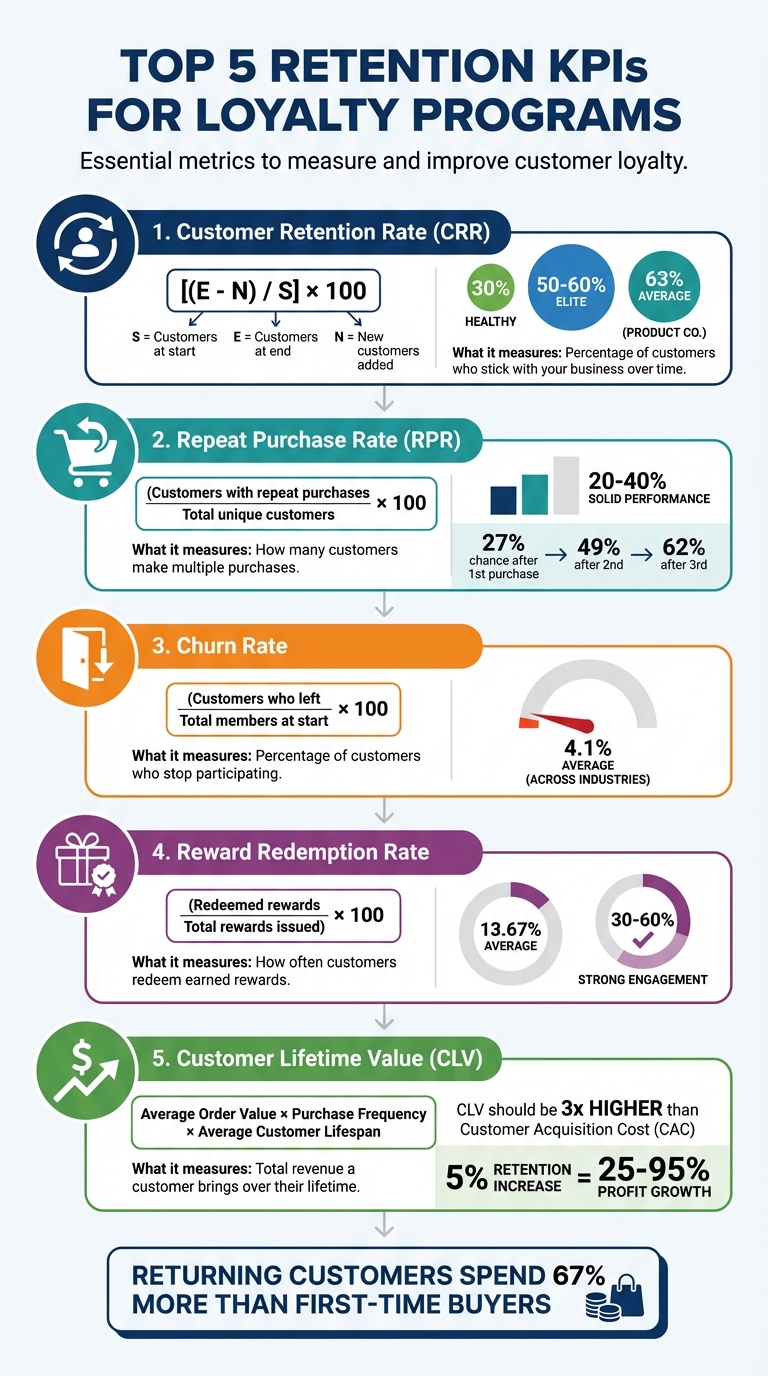
5 Essential Retention KPIs for Loyalty Programs with Formulas and Benchmarks
6 Ways to measure the success of a loyalty program | Successful loyalty metrics | [Loyltwo3ks]
1. Customer Retention Rate
Customer Retention Rate (CRR) measures the percentage of existing customers who stick with your business over a specific time frame. Essentially, it’s a snapshot of how well your loyalty program is working – do your rewards keep customers coming back, or are they losing interest?
The formula for CRR is simple: [(E – N) / S] x 100. Here’s what those letters mean:
- S: Number of customers at the start of the period
- E: Number of customers at the end of the period
- N: Number of new customers added during that time
For example, if you begin a quarter with 200 customers, gain 70 new ones, and end with 250, your CRR would be ((250 – 70) / 200) x 100 = 90%.
"This KPI reveals the percentage of customers returning over a specific period." – Kangaroo Rewards
In eCommerce, a retention rate of about 30% is considered healthy, though top-performing brands often hit 60% or higher. For product-based companies, the average is around 63%. Falling below 30%? That’s a warning sign – your loyalty program might need a serious overhaul. On the other hand, if you’re hitting 50–60%, you’re among the industry’s elite.
To truly understand your CRR, segment your data. Compare loyalty program members with non-members to see if your rewards are making an impact. A drop in CRR could mean it’s time to rethink your program – whether it’s the rewards themselves, how you communicate with customers, or the overall user experience. Once you’ve analyzed CRR, move on to the Repeat Purchase Rate to dig deeper into customer engagement.
2. Repeat Purchase Rate
The Repeat Purchase Rate (RPR) is all about understanding how many of your customers come back for more. It’s calculated as the percentage of customers who make more than one purchase within a specific timeframe. While Customer Retention Rate (CRR) measures loyalty, RPR zeroes in on those who are actively spending.
Here’s the formula:
(Customers with repeat purchases / Total unique customers) x 100
For example, if 350 out of 1,000 unique customers make repeat purchases, your RPR would be 35%. For most businesses, an RPR between 20% and 40% is considered a solid benchmark.
"Repeat purchases are the lifeblood of any successful loyalty programme."
– Propello Cloud
Here’s why RPR is so important: A first-time buyer has only a 27% chance of making another purchase. But after their second purchase, this jumps to 49%, and after the third, it skyrockets to 62%. This makes it crucial for your loyalty program to help customers clear that first hurdle of making a repeat purchase. Once they do, they’re far more likely to become regular buyers.
To truly measure your loyalty program’s effectiveness, compare the RPR of loyalty members to non-members. If members are buying more often, your program is doing its job. If the difference is minimal, it might be time to rethink your rewards structure or how you’re personalizing communication. Keep an eye on your RPR monthly or quarterly to identify trends and make necessary adjustments.
Up next, take a closer look at customer departures with the Churn Rate.
3. Churn Rate
Churn rate shows the percentage of customers who stop participating in your loyalty program over a set period. To calculate it, divide the number of customers who left during that time by the total number of members at the beginning, then multiply by 100. For instance, if 100 out of 2,000 loyalty members drop off in a quarter, your churn rate is 5%.
"Churn is the silent killer of weak loyalty programs."
– Mark Camp, CEO & Founder, Propello Cloud
Currently, the average customer churn across industries is about 4.1%.
There are two main types of churn. Voluntary churn happens when members actively leave, often due to dissatisfaction or better options elsewhere. Involuntary churn is more passive, caused by things like expired payment methods or cards. For free programs, churn is harder to track because members simply stop participating, while for paid programs, cancellations are much more noticeable.
To combat churn, start by analyzing your data to spot trends or patterns in why members leave. Exit surveys can provide quick insights – whether it’s simplifying the redemption process, improving rewards, or fixing technical issues. Pay attention to early warning signs like fewer logins or decreased point activity, and take action before members fully disengage.
Next, let’s look at how to measure member engagement with the Reward Redemption Rate.
sbb-itb-94e1183
4. Reward Redemption Rate
The reward redemption rate shows the percentage of earned points that customers exchange for benefits. You calculate it by dividing the number of redeemed rewards by the total rewards issued, then multiplying the result by 100. For instance, if you issued 10,000 points and members redeemed 3,000, your redemption rate would be 30%.
An average redemption rate sits at 13.67%. Rates between 30% and 60% indicate that your rewards program is connecting well with customers. On the other hand, lower rates could mean your rewards are too hard to earn, irrelevant, or that the redemption process is overly complicated.
"A high redemption rate indicates that customers find your rewards valuable and easy to use. On the flip side, a low rate suggests that your rewards may not be hitting the mark." – Mark Camp, CEO & Founder, Propello Cloud
Customers who actively redeem points tend to spend more and demonstrate stronger loyalty compared to those who simply accumulate points. To encourage redemption, try adding a points tracker to the home screen of your app so members can easily see how close they are to their next reward. You can also diversify your reward tiers – offer smaller, "quick win" rewards to engage newer members and bigger rewards to reward long-term loyalty. Personalized reminders about available points and upcoming expiration dates can also help create a sense of urgency without frustrating users.
Next, we’ll explore how to measure long-term member value with Customer Lifetime Value.
5. Customer Lifetime Value (CLV)
Customer Lifetime Value (CLV) is a way to estimate how much revenue a single customer will bring to your business throughout their time with your brand. Unlike metrics that only look at past sales, CLV focuses on the future, helping you pinpoint your most profitable customers and predict upcoming revenue opportunities.
This metric is especially useful when assessing the impact of loyalty programs. By comparing the CLV of loyalty members against non-members, you can measure the "loyalty lift" created by your retention strategies. Here’s a simple formula to calculate it:
CLV = Average Order Value × Purchase Frequency × Average Customer Lifespan.
For a more accurate financial picture, include profit margins in your calculations. This not only validates your loyalty program investments but also highlights how customer retention contributes to overall financial performance.
The numbers back up CLV’s importance in predicting profitability. For instance, returning customers spend an average of 67% more than first-time buyers, and increasing retention by just 5% can lead to profit growth of 25% to 95%. A strong business typically achieves a CLV that’s at least three times higher than its Customer Acquisition Cost (CAC). Case studies have shown that focusing on high-CLV customers can drive revenue growth while cutting down acquisition expenses.
"If 20% of the customers in your loyalty program are responsible for 80% of its future profit, then identifying this 20% is vitally important to the health of the program." – Len Llaguno, Founder, KYROS Insights
To get the most out of CLV, consider segmenting your loyalty members by tier (e.g., Bronze vs. Gold) to see if premium perks encourage higher long-term value. Keep an eye on engagement metrics like email click-throughs and visits to your program page – these behaviors can hint at potential CLV growth or signal churn risks. If a high-value customer’s predicted CLV starts to decline, act quickly with reactivation strategies.
Conclusion
Tracking these five retention KPIs – Customer Retention Rate, Repeat Purchase Rate, Churn Rate, Reward Redemption Rate, and Customer Lifetime Value – takes the guesswork out of driving revenue. Together, they paint a clear picture of your program’s health, helping you spot at-risk members and identify your most valuable customers. As Peter Drucker wisely said, "What gets measured, gets managed".
The financial impact of focusing on retention is hard to ignore. Even a modest 5% boost in retention can lead to a profit increase of 25% to 95%. These metrics act as an early warning system, allowing you to fine-tune rewards or improve the user experience before bigger issues arise.
To stay on top of your program’s performance, make regular monitoring a priority. Set SMART goals like "increase Redemption Rate by 15% in 6 months" and review progress monthly or quarterly to measure success. Real-time dashboards can simplify this process by pulling data from your CRM, POS systems, and e-commerce platforms into one place.
Tools like meed’s analytics dashboards make tracking these metrics even easier. From monitoring reward redemption trends to evaluating customer lifetime value, meed provides real-time insights. Features like digital stamp cards, QR code rewards, and wallet integration help you adapt your strategies quickly and keep engagement levels high.
FAQs
What are the best ways to improve my Customer Retention Rate?
To improve your Customer Retention Rate (CRR), the first step is to measure it accurately. Here’s how: subtract the number of new customers acquired during a specific period from the total customers at the end of that period. Then, divide this number by the total customers at the start of the period and multiply by 100 to express it as a percentage. This calculation gives you a clear baseline to work from. After that, shift your focus to key retention metrics like redemption rate, Customer Lifetime Value (CLV), and repeat purchase frequency to identify areas for improvement.
Once you’ve got the numbers, it’s time to act. Make rewards simple to access and redeem – this can be a game-changer. For example, display reward balances and special offers prominently in your app or digital wallet. Personalize those rewards based on a customer’s purchase history to make them feel valued. Tools like digital stamp cards or QR code-based rewards can also make earning and redeeming points a breeze.
Additionally, stay on top of customer activity trends. Spot signs of inactivity early and run targeted campaigns – like email reminders or push notifications – to bring those customers back into the fold. By consistently tracking these metrics and offering rewards that are easy to use and relevant to your audience, you can transform occasional buyers into loyal, repeat customers.
How can I increase my Repeat Purchase Rate (RPR) through a loyalty program?
To improve your Repeat Purchase Rate (RPR), focus on creating a loyalty program that keeps customers engaged and eager to return. Start by highlighting rewards prominently – let members easily see their points balance and how close they are to their next reward. This simple step keeps your program top-of-mind and motivates customers to stay active.
Introduce tiered incentives to make your program even more appealing. For example, offer bonus points when customers hit specific spending milestones or run special promotions like "double-point" days. These tactics add a sense of urgency and excitement. Personalizing rewards based on past purchases – such as exclusive discounts or product-specific perks – makes your offers feel more relevant, boosting the likelihood of repeat sales.
Lastly, make redeeming rewards as effortless as possible. Tools like digital stamp cards or QR codes that integrate with mobile wallets like Apple Wallet or Google Pay can streamline the process. A smooth, mobile-friendly experience reduces hassle and encourages customers to keep coming back.
What is Customer Lifetime Value (CLV) and how can it improve my loyalty program?
Customer Lifetime Value (CLV) measures how much revenue a single customer is likely to bring to your business throughout their entire relationship with you. It’s a key metric for identifying your most profitable customers and refining your loyalty program to maximize returns.
Here’s how to calculate CLV in three simple steps:
- Find the average purchase value: Divide your total sales by the number of orders placed.
- Determine purchase frequency: Divide the total number of orders by the number of unique customers within a specific timeframe (like a year).
- Estimate customer lifespan: Use metrics such as retention or churn rates to determine how long, on average, a customer continues to engage with your business.
With a clear understanding of CLV, you can create loyalty tiers for your top customers, match rewards to profitability, and even predict revenue outcomes when adjusting your program. Focusing on CLV transforms your loyalty program into a strategic tool for increasing retention and driving sustained growth.